Does Scalp Massage Help Hair Growth? What the Research Really Says
Introduction
Scroll through enough hair-care content and you’ll eventually run into the claim that a few minutes of scalp massage each day can help your hair grow thicker, faster, or fuller. It’s a comforting idea, low effort, free, and easy to fit into a daily routine, but it’s worth asking whether the science actually backs it up.
The short answer: does scalp massage help hair growth? Possibly, in a modest and still fairly limited way, based on early research, but it isn’t a proven treatment for hair loss, and it isn’t going to reverse significant thinning on its own. Scalp massage and hair growth are genuinely connected in a physiological sense; mechanical stimulation does appear to influence cells involved in hair growth, but the evidence so far is preliminary, based on small studies, and shouldn’t be oversold as more than what it currently is.
This article walks through what the research actually shows, how scalp massage might plausibly affect hair follicles, what it can realistically offer as part of a hair-care routine, and where its limits are.
Does Scalp Massage Help Hair Growth?
The most honest direct answer is: it might help a little, under specific conditions, but it’s not a proven hair-growth treatment on its own. This is really the central question behind does scalp massage work as advertised, and the honest answer is more nuanced than a simple yes or no.
The confusion here often comes from mixing up a few different things that scalp massage can influence. Improved scalp condition, a sense of relaxation, and a temporary boost in blood flow are all reasonably well-supported, immediate effects of massaging the scalp. Actual hair-growth outcomes, more hair, thicker strands, reduced shedding over time, are a separate question, and the evidence supporting that specific outcome is much thinner and far less conclusive.
It’s a distinction worth sitting with. Feeling like your scalp is healthier after a massage is a real, noticeable experience. Whether that translates into measurably more hair over weeks or months is a different claim entirely, and one that current research can only partially support. Scalp massage hair growth claims online often blur these two categories together, which is part of why the topic gets more confusing than it needs to be.
How Could Scalp Massage Affect Hair Growth?
Even without strong clinical proof, there are plausible, biologically reasonable mechanisms researchers have proposed for why does scalp massage help hair growth might have some basis in physiology.
Circulation. Massaging the scalp temporarily increases blood flow to the area. Since blood carries oxygen and nutrients to hair follicles, the theory is that improved circulation could support a healthier follicle environment. This is a reasonable hypothesis, but increased blood flow during a massage session doesn’t automatically prove a lasting effect on hair growth itself.
Mechanical stimulation. This is the mechanism with the most direct research behind it. Physically stretching the scalp’s tissue appears to place mechanical stress on the dermal papilla, a structure at the base of the hair follicle that plays a role in regulating hair growth cycles. In cell studies, this kind of mechanical stress has been linked to changes in gene activity associated with hair growth signaling.
Reduced tension. Chronic tightness in the scalp and surrounding muscles, sometimes associated with stress, is occasionally discussed as a factor that could indirectly affect the scalp environment, though this connection is more theoretical than firmly established.
It’s important to be clear that these are proposed mechanisms, not settled facts. They offer a reasonable explanation for why can scalp massage help hair growth in theory, but a plausible mechanism isn’t the same as proof of a real-world outcome.
What Does Research Say About Scalp Massage and Hair Growth?
The research in this specific area is genuinely limited, and being upfront about that is more useful than pretending otherwise when answering does scalp massage help hair growth with any real confidence.
The most frequently cited study, published in 2016 in the journal Eplasty, looked at nine healthy men who received four minutes of standardized scalp massage daily, using a mechanical device, for 24 weeks. One side of the scalp was massaged while the other served as a comparison. By the end of the study, the researchers measured a small but statistically significant increase in hair thickness on the massaged side. Notably, hair count actually dipped temporarily partway through the study, and the rate of hair growth itself didn’t show a significant change. The same research team also cultured hair follicle cells in a lab and found that mechanically stretching those cells activated certain genes associated with hair growth signaling.
That’s a genuinely interesting finding, but it comes with real limitations worth naming directly:
- The study included only nine participants, all men, which makes it hard to generalize to a broader population.
- The researchers didn’t perform tissue biopsies afterward, so the underlying biological changes weren’t directly confirmed in human scalp tissue, only inferred from measurements and separate lab-based cell experiments.
- There was no long-term follow-up beyond the 24-week study period.
- Hair count, arguably one of the more meaningful outcomes for someone concerned about hair loss, didn’t show a clear, sustained improvement.
Beyond this study, most of what’s discussed online about scalp massage and hair growth draws on this same limited body of evidence, extrapolated further than the original research really supports. There isn’t a robust body of large, well-controlled clinical trials establishing scalp massage as an effective standalone treatment for hair loss, and until that exists, does scalp massage help hair growth remains a promising but unproven question rather than a settled one. That doesn’t mean the idea is baseless, it means the science is still early, and claims about does scalp massage help hair growth should be scaled to match what’s actually been shown so far.
Potential Benefits of Scalp Massage
Even setting aside the unresolved question of hair growth specifically, scalp massage offers a few benefits that are worth acknowledging on their own terms.
- Relaxation. Many people find scalp massage genuinely calming, and a few minutes of mindful touch can be a small, pleasant part of winding down.
- Temporary reduction in scalp tension. Gentle massage can ease a sense of tightness across the scalp, particularly for people who carry stress in that area.
- Improved scalp-care routine. Incorporating massage into washing or applying scalp products can make an existing routine feel more intentional and consistent.
- Possible stimulation of the scalp. Based on the mechanisms discussed earlier, there’s a reasonable, if unproven, case that regular mechanical stimulation supports a healthier scalp environment over time.
- Support for overall hair-care consistency. People who build a small daily ritual, massage included, often find they’re more consistent with the rest of their hair-care habits too, simply because the routine has structure.
None of these benefits require scalp massage to be a proven hair-growth treatment to be worthwhile. They stand on their own as reasonable, low-risk additions to a self-care routine, independent of whether does massaging your scalp help hair grow turns out to be true in the stricter sense.
How to Massage Your Scalp for Hair Care
If you want to try incorporating scalp massage into your routine, the technique itself is simple and doesn’t require any special equipment.
- Use your fingertips, not your nails, applying firm but gentle pressure directly against the scalp.
- Move in small circular motions, gradually covering different areas rather than focusing on just one spot.
- Work systematically across the scalp, starting at the front hairline, moving toward the crown, and covering the sides and back.
- Avoid scratching or digging in with your nails, since this can irritate the skin rather than provide any meaningful benefit.
- Keep the pressure comfortable, somewhere between a light touch and something that feels genuinely therapeutic, without causing pain.
A simple routine many people follow is massaging for a few minutes before or during a shower, when the scalp is already warm and slightly more relaxed, though it can just as easily be done dry, at any point in the day. This kind of consistent, gentle habit is really what most scalp massage for hair growth advice comes down to in practice.
How Long Should You Massage Your Scalp?
Most of the available guidance, including the duration used in the research discussed earlier, points toward short, consistent sessions rather than long, infrequent ones.
Somewhere around four to five minutes per session, done daily or close to it, aligns with what’s actually been studied. Consistency over time appears to matter more than the intensity or length of any single session.
It’s also worth saying plainly: more aggressive or longer massage isn’t necessarily better. Excessive pressure or overly vigorous rubbing can irritate the scalp rather than help it, and there’s no evidence that pushing harder or longer produces a proportionally bigger benefit for does scalp massage help hair growth outcomes. A gentle, sustainable habit is more useful than an intense one you’re unlikely to keep up with.
Can a Scalp Massager Be Used Instead of Your Fingers?
Yes, and for a lot of people, a dedicated tool ends up being more practical than fingers alone.
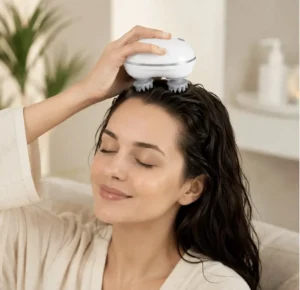
When people ask does scalp massage help hair growth without a tool, the answer is that manual massage with your fingertips is free, requires no equipment, and works perfectly well. The tradeoff is consistency, some people find it easy to skip or rush through a manual routine, especially on busy days. A scalp massager for hair growth, whether a simple silicone tool or an electric device, can make the process faster, more consistent, and in some cases, more evenly applied across the scalp than fingers alone typically manage.
Electric or vibrating scalp massagers, similar in concept to the device used in the research discussed earlier, can offer a standardized level of pressure and movement that’s harder to replicate by hand session after session. That consistency may matter more than the tool itself, since the research pointing to any benefit at all was built around a regular, repeated routine rather than occasional use.
It’s also worth noting that modern scalp devices increasingly combine massage with other technologies, rather than offering massage alone, which is a trend worth understanding before choosing a tool if you’re specifically trying to answer does scalp massage help hair growth for your own routine.
Can Red Light Therapy and Scalp Massage Be Used Together?
They can, and it’s becoming a fairly common combination in newer scalp-care devices. Red light therapy, which uses low-level light wavelengths and has its own separate, more established body of research specifically related to hair density in certain types of hair loss, is sometimes built into the same handheld tools used for scalp massage.
The appeal of combining the two is straightforward: one device addresses mechanical stimulation while the other addresses a different, light-based mechanism, without requiring two separate routines. Whether combining them produces a better outcome than either used alone hasn’t been extensively studied as a specific combination, so it’s worth treating that pairing as a reasonable, practical convenience rather than a scientifically confirmed synergy that definitively answers does scalp massage help hair growth when paired with light therapy.
For readers curious about how this combination works in an actual product, our review of the ROVAY Red Light Therapy Scalp Brush takes a closer look at how one device handles both massage and light therapy together, including what its intensity settings and usage instructions look like in practice.
What Scalp Massage Cannot Do
It’s worth being direct about the limits here, since overpromising on does scalp massage help hair growth does readers a disservice.
Scalp massage is not a proven cure for hair loss, and it shouldn’t be treated as a substitute for evaluating the actual cause of thinning or shedding hair. Hair loss can stem from a wide range of causes, genetics, hormonal changes, certain medical conditions, nutritional factors, and more, and scalp massage doesn’t address any of these underlying causes directly, which is a central limitation anytime does scalp massage help hair growth comes up in a conversation about actual hair loss.
It also isn’t going to reverse every form of hair loss, and there’s no credible evidence suggesting it works equally well, or at all, across every type of hair thinning someone might experience. If you’re noticing significant, sudden, or patchy hair loss, or thinning that seems out of the ordinary, that’s a reasonable signal to see a dermatologist or healthcare provider rather than relying on massage alone to address it. A professional can help identify what’s actually going on and whether other treatments are appropriate.
Frequently Asked Questions
Does scalp massage make hair grow faster? There isn’t strong evidence that it speeds up the rate of hair growth specifically. Answering does scalp massage help hair growth faster requires more research than currently exists; the main study in this area found improved hair thickness over time, but no significant change in growth rate.
How often should you massage your scalp? Daily, or close to it, for around four to five minutes per session, reflects the routine used in the available research and is a reasonable, sustainable target.
Can scalp massage help thinning hair? Does scalp massage help hair growth in cases of thinning specifically hasn’t been well studied on its own. It may offer some modest support as part of a broader routine, but it isn’t established as an effective standalone treatment for thinning hair, and significant thinning is worth having evaluated by a professional.
Is a scalp massager better than using your fingers? Not necessarily better in terms of outcome for does scalp massage help hair growth specifically, but often more convenient and consistent, which may matter more than the tool itself given how important regular use appears to be.
Can scalp massage cause hair loss? Gentle massage is generally considered low-risk. However, aggressive pressure, scratching, or pulling at the hair during massage could plausibly contribute to breakage or irritation, so a gentle approach is the safer choice.
How long should you massage your scalp? Around four to five minutes per session is a reasonable target, based on the duration used in available research, with daily consistency mattering more than any single longer session.
Conclusion
So, does scalp massage help hair growth? The most accurate answer sits in the middle: early, limited research suggests it may modestly improve hair thickness through mechanical stimulation of the scalp, but it isn’t proven to speed up growth, regrow lost hair, or address the underlying causes of hair loss. What it does reliably offer, relaxation, a healthier-feeling scalp, and an easy addition to an existing hair-care routine, is worthwhile on its own, even without overstating what the science currently supports.
If you decide to try it, consistency matters more than intensity. A few gentle minutes most days, whether with your fingertips or a dedicated tool, is a reasonable, low-risk habit to build. Just keep your expectations realistic, and if you’re dealing with meaningful hair loss, treat scalp massage as a small complement to your routine rather than a solution on its own, and consider talking to a professional about what else might be going on. The next time you find yourself asking does scalp massage help hair growth, that balanced, evidence-aware framing is the most accurate answer available today.