Red Light Therapy and Hair Loss: Is It as Good as People Think?
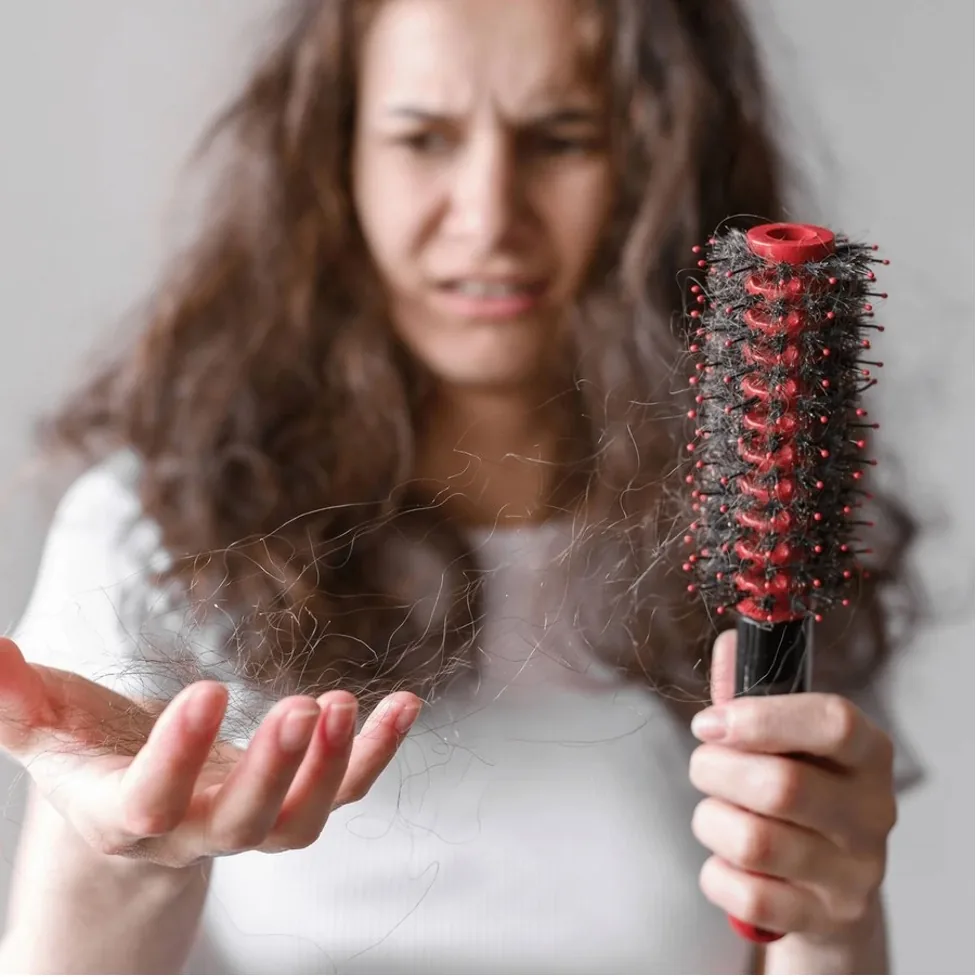
Hair loss has created a booming industry built on hope
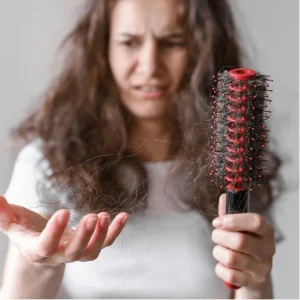
Woman examining hair loss in a hairbrush
If you’ve spent any time on TikTok, Instagram or YouTube recently, you’ve probably seen them.
Someone puts a futuristic-looking device on their head, switches it on and suddenly, their scalp is glowing beneath a sea of red lights.
Sometimes it’s a helmet.
Sometimes it’s a cap.
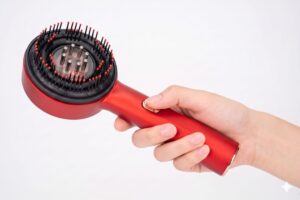
Other times, it’s a comb, brush or handheld device slowly moving across someone’s scalp.
The promise is usually just as attention-grabbing as the device itself: thicker hair, less shedding and the possibility of growing back what you’ve lost.
No surgery.
No needles.
No expensive salon appointments.
And unlike some hair-loss treatments, potentially no daily medication to swallow.
Just sit beneath a glowing red light for a few minutes and let the device do its thing.
It sounds almost too easy.
And perhaps that’s exactly why red light therapy has become one of the most talked-about treatments for thinning hair.
Because hair loss has created a booming industry built on hope.
There are oils promising to strengthen your roots. Supplements claiming to give you thicker hair. Shampoos designed to “stimulate growth.” Scalp serums. PRP treatments. Hair transplants.
And now, increasingly, glowing red helmets, caps, combs and brushes.
For someone watching their hair slowly change, the appeal is easy to understand.
Maybe your part is getting wider.
Maybe your ponytail doesn’t feel as thick as it once did.
Maybe you’re noticing more hair in the shower, on your pillow or tangled around your brush.
Or perhaps you’re watching your hairline slowly move backwards and wondering when exactly it started.
Hair loss can be deeply personal.
For many of us, hair is tied to identity, confidence and the way we see ourselves. So when something promises fuller, healthier-looking hair without surgery or invasive treatments, it’s understandable that people pay attention.
And pay money.
Sometimes, a lot of money.
Some red light therapy devices cost hundreds or even thousands of dollars. And the marketing surrounding them can be incredibly convincing.
Clinically proven.
Medical-grade.
FDA-cleared.
Stimulates dormant follicles.
Promotes natural hair growth.
But how much of that excitement is backed by real science?
That is what we wanted to find out.
Because the truth about red light therapy is more interesting than either extreme.
It isn’t simply a scam.
But it isn’t a magic cure for baldness either.
There is genuine scientific research suggesting that certain forms of low-level light therapy may help improve hair growth, particularly for people experiencing pattern hair loss.
But that doesn’t mean every glowing red device you see online will produce the same results.
It doesn’t mean every type of hair loss will respond to treatment.
And it definitely doesn’t mean you can put on a red light helmet today and wake up next month with the hair you had at 18.
So in this article, we’re cutting through the hype.
We’re going to look at what red light therapy actually is, how it is supposed to work, what the science really says about hair regrowth, who it may be most useful for and, perhaps most importantly, whether these increasingly expensive devices are actually worth your money.
Because before you spend hundreds of dollars sitting under a glowing red light, there is one question that deserves an honest answer:
Is red light therapy for hair loss really as good as people think?
Let’s find out.
What Exactly Is Red Light Therapy for Hair Loss?
Before we get into whether red light therapy can actually help you grow more hair, let’s clear up one thing first.
What exactly is it?
Because despite the futuristic-looking helmets and glowing devices all over social media, red light therapy is not simply about shining a red-coloured light onto your scalp.
Red light therapy is a treatment that uses specific wavelengths of light to interact with cells in the body. You may also hear it called low-level light therapy, low-level laser therapy or photobiomodulation.
Those names sound complicated, but the basic idea is fairly simple.
Certain wavelengths of red and near-infrared light are delivered to the scalp with the goal of influencing biological processes around the hair follicles.
For hair loss, this technology now comes in several forms.
You can find:
- Red light helmets/caps
- Red light brushes/combs
- Laser caps
- Hair-growth combs
- Handheld brushes
- Scalp devices
- LED-based hair-growth devices
They may all look different, but they are generally trying to do the same thing: deliver light to the scalp where the hair follicles live.
And that last part matters.
Your hair itself isn’t what needs the treatment.
The scalp is.
More specifically, the target is the hair follicle beneath the surface of your skin.
That is why many hair-growth devices are designed to part through the hair, sit directly against the scalp or cover the entire head. The idea is to get the light as effectively as possible to the area where hair growth begins.
But here’s where things can become confusing for consumers.
Not Every Red Light Is the Same
This is one of the biggest misunderstandings surrounding red light therapy.
A device glowing red does not automatically mean it is a scientifically designed hair-growth treatment.
There is a difference between a product simply having red lights and a device specifically designed to deliver particular wavelengths and levels of light for a particular purpose.
And unfortunately, as red light therapy becomes more popular, the market is becoming crowded.
You’ll see devices described as:
- Professional-grade.
- Medical-grade.
- Advanced LED technology.
- Clinical-strength red light.
- Hair follicle stimulation technology.
Some of those descriptions may sound impressive, but they don’t automatically tell you whether a device will work.
That is why consumers need to look beyond the glow.
Questions such as these matter much more:
- What type of device is it?
- What wavelengths of light does it use?
- Is it specifically designed for hair loss?
- Has that particular type of technology been studied?
- How much of the scalp does it cover?
- How often are you expected to use it?
- What evidence does the company provide for its claims?
Because one of the mistakes people make is assuming that if red light therapy has scientific evidence behind it, then every product marketed as a red light therapy device must also work.
That’s a bit like saying that because exercise is good for your health, every piece of equipment sold in a fitness shop will automatically make you fit.
The principle may be legitimate.
The individual product still matters.
And this brings us to something else that is often misunderstood.
Red Light Therapy Isn’t the Same as UV Light
For some people, the idea of deliberately shining light onto their scalp immediately raises an understandable question:
Wait. Isn’t light exposure bad for your skin?
The answer depends heavily on the type of light we’re talking about.
Red light therapy is very different from ultraviolet, or UV, light.
UV radiation is the type of light associated with sun damage. Too much exposure to UV can damage the skin and increase the risk of skin cancer.
Red light therapy devices used for cosmetic or therapeutic purposes do not work in the same way as UV tanning devices.
They use different parts of the light spectrum.
That distinction is important because the words “light therapy” can make everything sound like the same thing when it absolutely isn’t.
So no, using a properly designed red light device for your scalp is not the same as exposing your head to harmful UV rays or sitting under a tanning bed.
And another question people often have is:
Does the Red Light Get Hot?
Generally, red light therapy devices used for low-level light treatments are not designed to work by heating or burning the scalp.
That’s an important distinction.
The goal is not to cook your hair follicles into growing.
The light is intended to interact with tissue at relatively low levels rather than using intense heat to create an effect.
Depending on the device, you may feel some warmth, particularly during a longer treatment session, but a properly functioning device should not feel like it is burning your scalp.
If something is becoming painfully hot, causing burning or creating significant discomfort, that’s not something you should simply ignore and push through because you want faster results.
More is not always better with light-based treatments.
Following the manufacturer’s instructions matters.
And that leads us to the much more important question.
Because now that we understand what red light therapy actually is, we need to talk about what it is supposed to do once that light reaches your scalp.
How Is Red Light Supposed to Help Hair Grow?
This is where the idea behind red light therapy starts to sound a little more scientific and, admittedly, a little more complicated.
But stay with me.
Your hair doesn’t simply grow continuously forever. Every single hair follicle moves through a natural cycle that includes periods of growth, transition and rest.
The most important phase for our conversation is called the anagen phase. This is the active growth stage, when the follicle is producing hair.
Eventually, the follicle moves through other stages, including a resting phase, before the hair sheds and the cycle begins again.
That cycle is perfectly normal.
The problem begins when something interferes with it.
In people with certain types of hair loss, particularly androgenetic alopecia, also known as male or female pattern hair loss, the follicles gradually begin to change.
They can become smaller.
The hairs they produce may become thinner.
Each new growth cycle can produce shorter, finer hair than the one before it.
Over time, what was once thick, healthy hair may begin to look less dense. A scalp that was barely visible before may become easier to see. A part may widen. A hairline may gradually recede.
This is where red light therapy enters the conversation.
The Basic Theory
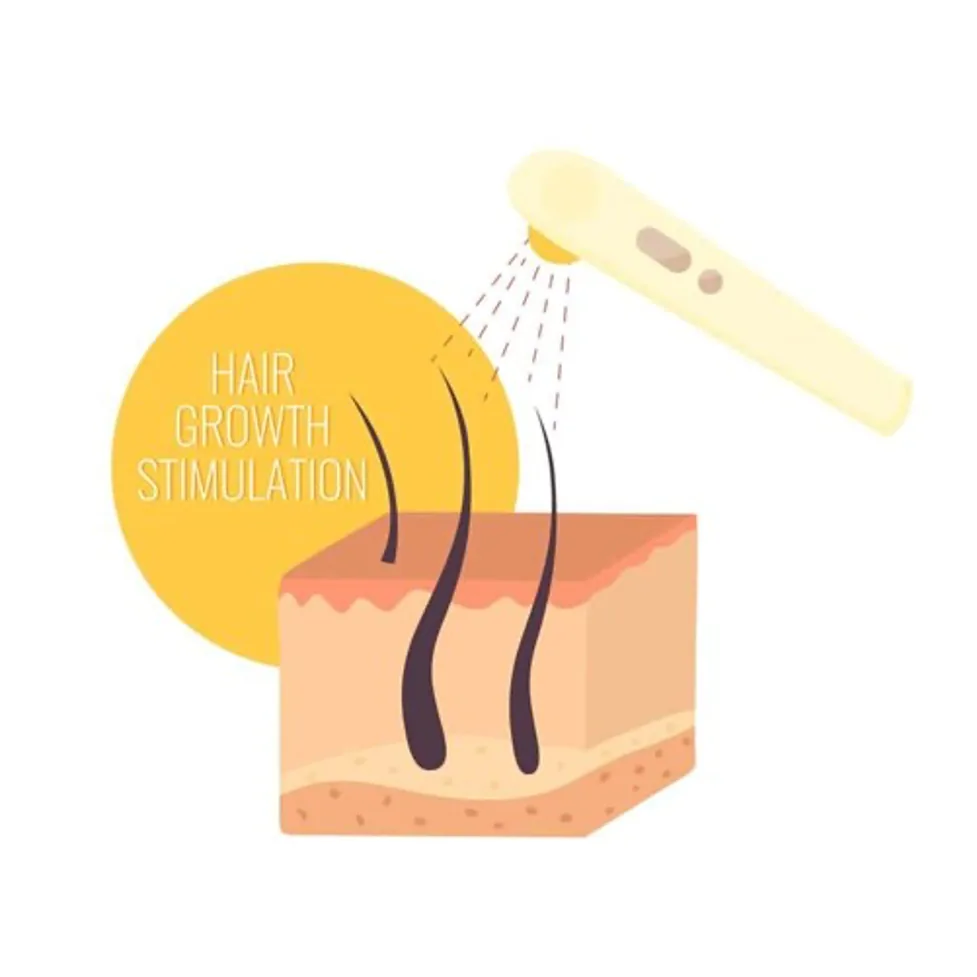
Illustration of light stimulating hair follicles beneath the scalp
Scientists believe that specific wavelengths of red and near-infrared light can interact with cells in ways that influence their activity.
One of the main ideas behind this process is that light may affect structures inside cells involved in energy production.
You can think of it like giving the cells involved in the hair-growth process a little encouragement to do their jobs.
Not magic. Not an instant reboot.
More like supporting the biological environment around a struggling hair follicle.
Researchers are still studying exactly how all of this works, but several possible effects have been explored.
Red and low-level light therapy may help influence:
- Cellular activity
- Energy production within cells
- Blood flow and circulation around treated tissue
- Signalling processes involved in growth and repair
- The hair-growth cycle itself
For hair follicles that are still alive but becoming weaker, these effects could potentially help support healthier growth.
And that distinction is important.
Red Light Therapy Is Not a Resurrection Machine
Let’s address one of the biggest misconceptions right here.
When advertisements say things like “wake up dormant follicles,” it can create the impression that every bald area is filled with sleeping hair follicles waiting for someone to shine a red light on them.
That’s not necessarily how hair loss works.
There is a significant difference between a follicle that is still present but producing thinner, weaker hair and one that has been severely damaged or is no longer capable of producing visible hair.
Red light therapy is generally being studied as a way of supporting and stimulating existing follicles.
It is not the same as creating completely new hair follicles where none exist.
That is why the stage and cause of your hair loss can matter so much.
Someone who has started noticing that their hair is becoming thinner may have a different experience from someone who has had a completely bald area for decades.
And this is one reason why those dramatic before-and-after advertisements should always be viewed with a little caution.
Hair growth is not a one-size-fits-all process.
Two people can use the same device, for the same amount of time, and have completely different results.
One person may notice less shedding and fuller-looking hair.
Another may see very little change.
And someone else may discover that the real reason for their hair loss has nothing to do with the kind of problem red light therapy is designed to address.
What About Blood Circulation?
You’ve probably also seen companies say that red light therapy “boosts circulation” to the scalp.
The logic behind this claim is easy to understand.
Hair follicles need oxygen and nutrients to function properly, and blood vessels play an important role in delivering those things.
Some research suggests that low-level light may influence processes related to blood flow and circulation in treated tissue.
But this is another area where marketing language can sometimes get ahead of what consumers should realistically expect.
Improving circulation is not the same thing as guaranteeing hair growth.
You cannot simply increase blood flow to someone’s scalp and promise that their hair will automatically grow back.
Hair loss is much more complicated than that.
Genetics, hormones, inflammation, nutrition, illness and the condition of the follicles themselves can all play a role.
So while circulation may be part of the biological story, it is not the entire story.
And honestly, this is a good example of how the red light therapy industry sometimes oversimplifies the science.
A complicated biological process becomes:
“More blood flow = more hair.”
Reality is rarely that straightforward.
So What Is Red Light Therapy Actually Trying to Do?
If we strip away the marketing language, the goal is essentially this:
To support hair follicles that may still be capable of producing healthier hair.
The hope is that, through repeated and consistent exposure to specific wavelengths of light, the treatment can help encourage a more favourable environment for hair growth.
That might mean:
- Supporting follicles that are producing increasingly thin hair
- Encouraging follicles to spend more time in the growth phase
- Improving overall hair density over time
- Helping existing hair appear fuller and thicker
Notice something?
None of those promises involve waking up tomorrow with a completely new head of hair.
And that’s actually the key to understanding whether red light therapy is worth your attention.
The realistic potential of the treatment is far more interesting than the exaggerated promises.
Because if the science suggests that a non-invasive treatment can genuinely help some people improve hair density without surgery, that is worth talking about.
But now we get to the question that matters most.
Does science actually support all of this?
Because theories are one thing. Marketing is another.
And before anyone spends hundreds or thousands of dollars on a glowing helmet, cap or brush, we need to look at what the research has actually found.
What Does Science Actually Say About Red Light Therapy and Hair Loss?
This is the part where we separate the exciting marketing from the actual evidence.
Because it is one thing for a company selling a $500 glowing helmet to tell you that its device can transform your hair.
It’s another thing entirely for researchers to study the technology and compare it with a fake device that looks the same but does not deliver the treatment.
And the good news is that red light therapy has actually been studied.
The answer, however, is not quite as simple as “yes, it works” or “no, it’s a scam.”
The most honest answer is:
Yes, there is real scientific evidence that low-level light therapy can help some people with pattern hair loss.
But there are some very important words in that sentence: some people, pattern hair loss, and can help.
Those three things are where reality lives.
The Research Is More Promising Than You Might Expect
Low-level light therapy, often shortened to LLLT, has been studied in both men and women experiencing androgenetic alopecia, commonly known as male or female pattern hair loss.
This is the type of hair loss many people experience as they get older.
For men, it often shows up as a receding hairline or thinning around the crown.
For women, it can look different. A widening part, reduced density around the top of the head or a ponytail that gradually feels less substantial are common experiences.
Several clinical trials and reviews have found that low-level light therapy can improve measures such as hair density and hair thickness in people with pattern hair loss. A 2025 systematic review and meta-analysis covering 38 studies found a significant improvement in hair density for people with androgenetic alopecia who used low-level laser or LED therapy compared with placebo.pub.Med
That’s important.
Because this means the technology is not simply surviving on testimonials and dramatic before-and-after photographs.
There is actual research behind it.
The American Academy of Dermatology also notes that some large randomized controlled trials have found that repeated red light treatments can lead to some hair regrowth, including increases in hair thickness and length.aad.org
And if you’re wondering why randomized controlled trials matter, think of them as one of the better ways researchers can test whether a treatment is actually doing something.
Participants may be divided into groups.
One group receives the real treatment.
Another may receive a sham device, meaning something designed to look and feel like the real device without delivering the same therapeutic treatment.
That makes it easier to answer an important question:
Are people seeing results because the treatment works, or because they expect it to work?
When studies repeatedly find better results in the treatment group, that’s when researchers begin to take the technology more seriously.
So, Is Red Light Therapy Scientifically Proven?
This is where I would be careful with the word proven.
The internet loves that word.
Beauty companies love it even more.
But science is rarely as dramatic as an advertisement.
What we can say is that there is a meaningful and growing body of evidence supporting low-level light therapy as a treatment option for androgenetic alopecia.
A systematic review of randomized controlled trials found that low-level laser light therapy was superior to placebo for promoting hair growth in men with androgenetic alopecia.pub.Med
Another review examining clinical trials in both men and women concluded that low-level laser therapy appeared effective for pattern hair loss, with the studies reviewed showing improvements in hair diameter or density and generally minor side effects.pub.Med
So yes.
There is science here.
But, and this is a very big but, that does not mean every device being sold online deserves the same level of confidence.
Science supports technology, that doesn’t automatically mean it supports every product.
This is probably one of the most important things anyone shopping for a red light device needs to understand.
Let’s say scientific studies show that a certain medication can help headaches.
That does not mean every random tablet sold online and advertised as a headache cure works.
The same principle applies here.
The studies are conducted using specific devices, wavelengths, treatment schedules and protocols.
A cheap device with red lights may look similar to a clinically tested device.
That doesn’t automatically make them equivalent.
This is especially important now because red light therapy has become a major business.
Search online and you’ll find devices at almost every price point.
There are expensive helmets costing hundreds or thousands of dollars.
There are caps.
Combs.
Brushes.
And increasingly, inexpensive handheld devices claiming to offer the same benefits.
But not every device has been studied.
Not every device has the same specifications.
And not every company is equally transparent about what its product actually delivers.
A 2022 systematic review and meta-analysis of randomized controlled trials looking specifically at FDA-cleared, home-use low-level light/laser devices for pattern hair loss found a significant improvement in hair density compared with sham devices. But it also pointed out an important issue: the review was only able to include seven double-blind trials, even though dozens of home-use devices had already been FDA-cleared by that point.pub.Med In other words, the market contains many different devices, and relatively few have that level of evidence behind them specifically.
That distinction could save you a lot of money.
Because you shouldn’t be asking only:
“Does red light therapy work?”
You should also be asking:
“What exactly do we know about this particular device?”
And This Is Where the Marketing Can Get Ahead of the Science
You’ve probably seen some of the claims.
Wake up dormant follicles.
Regrow your hair naturally.
Visible results in weeks.
Reverse hair loss from home.
Some of these statements contain a little truth wrapped in a lot of optimism.
Yes, low-level light therapy may help stimulate hair growth in certain people.
Yes, some people may notice improvements in density.
But “may help improve hair growth” and “will reverse your hair loss” are two completely different promises.
And unfortunately, hair-loss marketing doesn’t always respect the difference.
The American Academy of Dermatology puts it quite clearly: some people can regrow some hair with repeated red light treatments, but the treatment will not regrow a full head of hair.
Honestly, I think that is one of the most important things to remember before buying one of these devices.
Red Light Therapy Can Be Helpful Without Being Miraculous.
Those two things can exist at the same time.
You don’t have to call something a scam because it doesn’t completely cure hair loss.
And you also don’t have to believe it is revolutionary because someone posted a dramatic transformation video online.
The realistic middle ground is often where the truth is.
For someone with early-stage pattern hair loss, even a modest improvement in hair density could be meaningful.
A slightly fuller crown.
A less visible scalp.
A part that doesn’t look quite as wide.
Hair that appears thicker overall.
Those changes may sound small when written on paper.
But to someone who has spent years watching their hair gradually become thinner, they can make a very real difference.
What About Before-and-After Photos?
Ah.
Now we are entering dangerous territory.
Because before-and-after photographs are probably one of the most powerful selling tools in the entire hair-loss industry.
And they can also be incredibly misleading.
That doesn’t mean every before-and-after photo is fake.
Absolutely not.
Some people genuinely experience impressive results.
But photographs can change dramatically depending on:
- Lighting
- Hair colour
- Hair length
- The angle of the camera
- Whether the hair is wet or dry
- Whether the hair has been styled
- How the hair is parted
- The use of fibres or styling products
A scalp photographed directly under bright overhead lighting can look significantly more visible than the same scalp photographed in softer lighting.
And anyone who has ever changed their hair part knows just how dramatically the appearance of thinning can change.
That is why scientific studies are much more useful than simply looking at one person’s transformation online.
Research can measure things like hair density and compare groups over time.
A TikTok video cannot.
So, enjoy the before-and-afters.
Let them inspire you.
Just don’t let them become your evidence.
What the Research Seems to Tell Us So Far
When you put the studies together, a fairly clear picture begins to emerge.
Low-level light therapy appears to be a legitimate treatment option, particularly for people with androgenetic alopecia.
The strongest evidence is currently for pattern hair loss rather than every possible cause of shedding or baldness. The 2025 systematic review and meta-analysis we mentioned earlier found the evidence especially promising for androgenetic alopecia specifically, while concluding that more research is needed to understand how effective LLLT may be for other types of alopecia.pub.Med
That means red light therapy may be worth considering if you’re dealing with:
- Male pattern hair loss
- Female pattern hair loss
- Gradual thinning associated with androgenetic alopecia
But if your hair has suddenly started falling out in large amounts?
That’s a different conversation.
If you have unexplained bald patches?
Different conversation.
If your hair loss began after an illness, major stress, pregnancy, medication or significant weight loss?
Again, different conversation.
And this is exactly why blindly buying a red light device because someone on TikTok said it “saved their hair” isn’t always the smartest first step.
The cause of your hair loss matters.
A lot.
Which brings us to the next question:
Who Is Red Light Therapy Most Likely to Work For?
This is probably one of the most important questions in the entire article.
Because if there is one thing you should take away from everything we’ve discussed so far, it is this:
Red light therapy is not a universal solution for every type of hair loss.
And that matters.
You can buy the most expensive red light helmet on the market, use it religiously and follow every instruction perfectly, but if the underlying cause of your hair loss is something the treatment is unlikely to address, your results may be disappointing.
So who is most likely to benefit?
People With Pattern Hair Loss
The strongest evidence for red light therapy is currently connected to androgenetic alopecia, more commonly known as pattern hair loss.
This affects both men and women, although it often looks very different depending on the person.
For men, pattern hair loss commonly appears as:
- A receding hairline
- Thinning around the temples
- A thinning crown
- Gradual baldness on the top of the head
For women, it may look more like:
- A widening hair part
- Reduced density around the crown
- Hair that gradually becomes finer
- A ponytail that feels noticeably thinner
- More scalp becoming visible through the hair
And this is where red light therapy may be particularly interesting.
Remember what we discussed earlier about hair follicles gradually becoming smaller and producing thinner hairs?
For someone in the earlier or moderate stages of pattern hair loss, there may still be follicles capable of producing hair.
The hair simply isn’t as thick or strong as it once was.
That is the kind of situation where a treatment designed to support follicular activity has a more realistic opportunity to make a difference.
Early-Stage Thinning May Be the Sweet Spot
If there is one thing the hair-loss industry doesn’t always tell people, it’s that timing can matter.
Many people wait until their hair loss becomes severe before looking for help.
They notice a few changes.
Ignore them.
Try a new shampoo.
Ignore them again.
Change their hairstyle to hide the thinning.
And eventually, when the problem becomes impossible to ignore, they begin searching for treatments.
But by that point, the hair loss may have progressed significantly.
Red light therapy is generally more appealing for people who are still in the stage of saying:
“My hair definitely isn’t as thick as it used to be.”
Rather than:
“I haven’t had hair in this area for 20 years.”
That doesn’t mean someone with significant hair loss cannot use red light therapy.
It simply means expectations need to be realistic.
The goal may be to improve the appearance and density of existing hair rather than expecting a completely bald area to suddenly become covered with thick new growth.
Women Experiencing Gradual Hair Thinning
Red light therapy is often marketed heavily towards men with receding hairlines.
But women make up a huge part of the conversation around thinning hair too.
In fact, female hair loss can be particularly frustrating because it is often less openly discussed.
A woman may not necessarily wake up with a dramatically receding hairline.
Instead, the changes can be subtle.
Her part becomes a little wider.
Her scalp becomes slightly more visible in photographs.
Her ponytail feels smaller.
She notices that she can no longer create the same volume she once could.
And because the changes happen gradually, it can sometimes take years before she realises just how much her hair has changed.
For women experiencing female pattern hair loss, low-level light therapy may be worth considering as one possible treatment option.
But again, identifying the cause matters.
Hair thinning in women can have many possible causes, including hormonal changes, nutritional deficiencies, illness and other medical conditions.
So if your hair loss is sudden, severe or unexplained, buying a red light device should probably not be your first move.
Understanding why your hair is falling out is.
Men With Thinning Hairlines and Crowns
For men, red light therapy may be most relevant during the stages when thinning is becoming noticeable but there is still hair present.
Maybe the temples are beginning to thin.
Maybe the crown is no longer as dense.
Maybe photographs taken from above have started becoming uncomfortable.
The earlier stages of pattern hair loss can be particularly frustrating because you know something is changing, but you’re not necessarily ready to consider something as dramatic as a hair transplant.
That’s where non-invasive options like red light therapy become attractive.
It can be done at home.
There is no surgery.
There are no needles.
And the routine can often fit into everyday life.
The trade-off?
Patience.
Because red light therapy is not a quick fix.
If you are the type of person who wants to try something on Monday and judge the results by Friday, this probably isn’t going to be your favourite treatment.
Hair grows slowly.
Any meaningful improvement in hair density is likely to take time.
People Who Are Consistent
Honestly?
This might be the most overlooked group of all.
Red light therapy is probably best suited to people who can actually stick to the routine.
That sounds obvious, but think about how many beauty and wellness products people buy with the best intentions.
The expensive serum that gets used for two weeks.
The vitamins sitting untouched in a cupboard.
The gym membership we won’t talk about.
Red light therapy isn’t something you use three times and then forget about for a month.
The studies showing potential benefits generally involve repeated treatments over extended periods.
That means consistency matters.
If you’re willing to make it part of your routine, you are much more likely to give the treatment a fair chance.
If the device ends up sitting in a drawer after two weeks, it probably won’t matter how advanced the technology is.
People With Realistic Expectations
This one might sound strange.
But having realistic expectations can genuinely change whether you consider a treatment successful.
Imagine two people using the exact same device.
After several months, both experience a measurable improvement in hair density.
Person number one is thrilled.
Their hair looks fuller. Their scalp is less visible. They feel more confident.
Person number two is disappointed.
Why?
Because they expected to completely reverse their hair loss.
The results were identical.
The expectations were not.
Red light therapy may be a good option for someone who understands that the goal is often improvement and maintenance, rather than a miraculous transformation.
For some people, preventing further thinning could be just as valuable as growing significant amounts of new hair.
And honestly, that point deserves more attention.
Sometimes Keeping the Hair You Have Is a Win
The hair-loss industry focuses heavily on regrowth.
And understandably so.
Grow your hair back is a much sexier promise than:
“Possibly slow down the progression of your hair loss.”
But in reality, maintaining your existing hair can be incredibly valuable.
Hair loss can be progressive.
That means doing nothing may result in continued thinning over time.
So if a treatment helps someone maintain better hair density or slow further deterioration, that can still be a meaningful result.
Unfortunately, this is also harder to see.
You may not wake up one morning and notice dramatic new hair.
Instead, months pass, and your hair simply hasn’t continued getting worse.
That may not make the most exciting TikTok before-and-after video.
But it can still matter.
So, Who Is the Ideal Candidate?
Based on what we currently know, red light therapy may be most worth exploring for someone who:
- Has gradual thinning rather than sudden unexplained hair loss
- Has male or female pattern hair loss
- Still has active hair follicles in the thinning areas
- Is noticing early or moderate thinning
- Is willing to use the device consistently
- Understands that results take time
- Wants a non-invasive treatment option
- Has realistic expectations about what improvement might look like
But now we need to talk about the other side of this.
Because not everyone experiencing hair loss should rush out and buy a glowing helmet.
And sometimes, using a red light device can distract you from finding the real reason your hair is falling out in the first place.
Who May Not Benefit From Red Light Therapy?
Now for the part that probably won’t appear in every advertisement selling a glowing red helmet.
Red light therapy is not the answer to every type of hair loss.
And this is important because hair loss is not a diagnosis.
It’s a symptom.
Two people can both say, “My hair is falling out,” while having completely different reasons for it.
One person may have genetic pattern hair loss.
Another may be experiencing shedding after a stressful period.
Someone else may have a nutritional deficiency.
Another person may have an autoimmune condition affecting their hair follicles.
The hair may look similar from the outside.
The cause may be completely different.
And that is why buying a red light device without understanding what is happening to your hair can sometimes lead to disappointment.
People With Sudden or Unexplained Hair Loss
If your hair has suddenly started falling out much more than usual, a red light device should probably not be the first thing you buy.
Sudden shedding can happen for many reasons.
It can sometimes follow:
- A major illness
- Significant stress
- Surgery
- Rapid weight loss
- Hormonal changes
- Pregnancy and childbirth
- Certain medications
- Nutritional deficiencies
In situations like these, the most important question isn’t necessarily:
“Which red light device should I buy?”
It’s:
“Why is this happening?”
Because if there is an underlying issue contributing to the shedding, identifying and addressing that issue may be far more important than adding another device to your bathroom shelf.
Red light therapy may eventually become part of someone’s routine, depending on the situation, but it should not become a substitute for investigating sudden or significant hair loss.
People With Patchy Bald Spots
If your hair is coming out in distinct patches rather than gradually thinning, that can be a sign of a different type of hair-loss condition.
For example, some forms of alopecia can cause relatively smooth, round or irregular bald patches.
This is not necessarily the same situation as a gradually widening part or a slowly thinning crown.
And the evidence supporting low-level light therapy is strongest for pattern hair loss, not every form of alopecia.
That means someone with patchy hair loss should be particularly careful about assuming that a red light helmet or brush will solve the problem.
Sometimes the smartest investment is not another hair-growth gadget.
It’s getting a proper evaluation first.
People Expecting to Regrow Hair on Completely Bald Areas
Let’s return to something we mentioned earlier because it is worth repeating.
Red light therapy is not a resurrection machine.
If an area has been completely bald for a very long time, expectations should be very different from someone who is dealing with recent thinning.
A follicle that is still producing fine, weak hair may potentially respond differently from an area where there is little or no active follicular activity left.
That doesn’t mean you can look at a bald area and immediately know what is happening underneath the skin.
But it does mean that advertisements suggesting every bald head is filled with sleeping follicles waiting to be “woken up” should be treated with caution.
Sometimes the marketing language makes the treatment sound far more powerful than the reality.
People Looking for Instant Results
If you need results next week for a wedding, holiday or reunion, red light therapy is probably not the solution you’re looking for.
Hair growth moves slowly.
Even when a treatment is working, changes usually need time to become visible.
This is one of the biggest reasons people give up too early.
They buy an expensive device.
Use it enthusiastically.
Check the mirror every morning.
Take pictures after two weeks.
See no dramatic transformation.
And decide it doesn’t work.
But that is not really how most hair-growth treatments work.
You are dealing with a biological process.
Hair needs time to move through its growth cycle.
And even if the treatment is having an effect beneath the surface, it can take time before that translates into a visible difference.
If patience isn’t something you’re willing to bring to the process, a red light device may become a very expensive decoration.
People Who Won’t Use It Consistently
This might sound harsh, but it’s true.
The best device in the world cannot help much if it spends most of its life inside a drawer.
Red light therapy requires consistency.
Exactly how often depends on the device and its instructions, but the general principle is the same.
One enthusiastic week followed by three weeks of forgetting is unlikely to produce the same results as a consistent routine over several months.
Before buying a device, ask yourself an honest question:
Will I actually use this?
A large helmet might provide excellent scalp coverage, but if you hate sitting underneath it and eventually stop using it, that advantage becomes meaningless.
A smaller brush may require more effort to move around the scalp.
But if it fits naturally into your morning routine, you may be more consistent with it.
The best device isn’t necessarily the one with the most impressive-looking technology.
It may be the one you will consistently use.
People Whose Hair Loss Requires a Different Treatment
Sometimes, red light therapy may be useful as part of a broader approach.
But it may not be enough on its own.
Depending on the cause of hair loss, other treatments may be more appropriate.
This is particularly important for people experiencing progressive or significant hair loss.
A person can spend months trying one product after another while the underlying condition continues.
And this is where the hair-loss industry can become frustrating.
There is always another product to buy.
Another oil.
Another supplement.
Another shampoo.
Another device.
But more products do not necessarily mean more progress.
Sometimes the most valuable thing you can do is pause and figure out what is actually causing the problem.
Red Light Therapy Shouldn’t Replace Medical Advice
This is particularly important if your hair loss is:
- Sudden
- Severe
- Painful
- Accompanied by itching or scalp irritation
- Occurring in patches
- Getting progressively worse very quickly
- Happening alongside other unusual symptoms
A red light device is a consumer product or treatment tool.
It is not a replacement for finding out whether something else is going on.
And honestly, this is one of the biggest problems with social media advice.
Someone posts a video saying:
“This saved my hair!”
Thousands of people immediately want the same product.
But we don’t know whether those thousands of people have the same type of hair loss.
They may not.
So, Does That Mean Red Light Therapy Isn’t Worth Trying?
Not at all.
It simply means you should approach it intelligently.
If you have gradual thinning that appears consistent with male or female pattern hair loss, red light therapy may be a reasonable option to explore.
If your hair suddenly started falling out in handfuls two weeks ago?
That’s probably a situation where you need answers before you need another gadget.
And this is actually what makes red light therapy more interesting to me.
When we stop treating it like a miracle cure, we can start looking at it for what it potentially is:
A legitimate, non-invasive tool that may help the right person, with the right type of hair loss, when used consistently.
But there is still something we need to clear up.
Because when you start shopping for these devices, you’ll quickly discover that the terminology becomes confusing.
Some products say LED.
Others say laser.
Some say red light.
Others say low-level laser therapy.
And the prices can be dramatically different.
So naturally, the next question is:
Red Light Therapy for Hair Loss: LED vs Laser. Does the Difference Actually Matter?
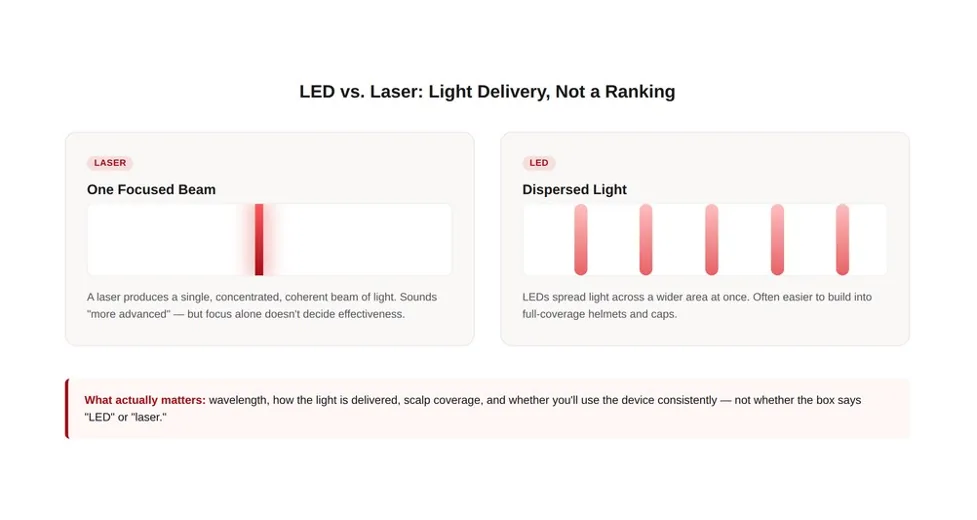
Diagram comparing a focused laser beam to dispersed LED light
Once you start seriously looking into red light therapy devices, you quickly run into another problem.
The terminology.
One company is selling an LED helmet.
Another is advertising a laser cap.
A third says it uses low-level laser therapy.
Then you find a brush with red LEDs and suddenly you’re wondering whether you’ve accidentally enrolled in a physics class just trying to buy something for your hair.
So let’s simplify it.
First, What Is the Difference Between LED and Laser Light?
Both LEDs and lasers can produce light at wavelengths used in low-level light therapy.
But they produce that light differently.
A laser produces a more focused and concentrated beam of light.
An LED, on the other hand, produces light that is generally more dispersed.
That difference has historically made people assume that lasers must automatically be better for hair growth.
After all, laser sounds more advanced.
More powerful.
More medical.
And, conveniently, more expensive.
But here’s the important part:
More Expensive Doesn’t Automatically Mean More Effective
When it comes to red light therapy for hair loss, the conversation is not as simple as:
Laser = good.
LED = bad.
Both technologies have been used in hair-growth devices, and both have been included in research into low-level light therapy.
What matters is not simply whether a device uses the word laser or LED on the box.
The bigger questions are:
- What wavelength does it use?
- How is the light delivered?
- How much of the scalp does the device cover?
- How consistently can the user apply the treatment?
- Has the device or similar technology actually been studied?
- Does the manufacturer provide meaningful information about how the product works?
Because a laser device can sound incredibly impressive while being inconvenient to use.
And an LED device can sound less glamorous while being easier for someone to use consistently.
And remember what we already established?
Consistency matters.
A treatment you use regularly is likely to give you a better chance of seeing results than an “advanced” device you stop using after three weeks because you hate the experience.
The Wavelength Matters More Than the Colour You See
This is another area where things can get confusing.
When we say red light, we’re not simply talking about the colour red that your eyes can see.
Different wavelengths of light have different properties.
Many hair-growth devices use wavelengths in the red-light range, often around the mid-600 nanometre range, although some devices may also use near-infrared light.
And yes, this is where companies often start throwing numbers at you.
630nm.
650nm.
660nm.
808nm.
850nm.
Suddenly, buying a hair-growth device starts feeling like buying a new laptop.
The important thing to understand is that those numbers refer to the wavelength of the light.
Different wavelengths can penetrate tissue differently, and researchers have investigated particular wavelength ranges for different therapeutic purposes.
But don’t fall into the trap of assuming that the biggest number automatically means the best device.
Or that a company listing more wavelengths automatically means better results.
The relationship between wavelength, power, treatment time and biological response is more complicated than that.
A good red light device isn’t simply the one with the longest list of impressive numbers.
What About Power? Is Stronger Better?
Again, not necessarily.
This is another place where marketing can make things confusing.
You might assume that a more powerful light must produce better results.
But with low-level light therapy, more is not automatically better.
The goal is to deliver an appropriate amount of light energy.
Too little may not produce much effect.
But that doesn’t mean you should keep increasing the intensity indefinitely and expect increasingly better results.
This is why following the recommended treatment time for a specific device matters.
Don’t assume that if a company recommends 15 minutes, using it for an hour will give you four times the results.
Your scalp isn’t a plant that grows faster because you leave the grow light on all night.
So, Should You Buy an LED Device or a Laser Device?
Honestly?
For most people, I wouldn’t make the decision based on that word alone.
Instead, I would look at the entire product.
Ask yourself:
Is the device designed specifically for hair loss?
A general red light panel designed for skin or muscle recovery may not necessarily be the most practical option for treating your scalp.
Hair creates a physical barrier, which is why devices specifically designed to reach the scalp can be more convenient.
Does it cover the areas you’re concerned about?
Someone with thinning across the entire top of their head may prefer a helmet or cap.
Someone focused on a particular area might find a handheld device easier to use.
Is the manufacturer transparent?
Can you find meaningful information about the technology?
Does the company clearly explain how to use the device?
Are the claims realistic?
Or does the website look like it was written entirely by someone who has just discovered the phrase “wake up dormant follicles”?
Will you actually use it?
This question deserves to appear every time you shop for a red light device.
A large helmet might cover your entire scalp.
That’s great.
But if it feels uncomfortable and you stop using it, the coverage doesn’t matter.
A smaller brush may require more effort to move around the scalp.
But if it fits naturally into your routine, you may be more consistent with it.
And consistency can be incredibly valuable.
LED vs Laser: The Bottom Line
There is no simple rule that says:
“Always buy laser.”
Or:
“LED devices don’t work.”
The science around low-level light therapy for hair loss is more nuanced than that.
Both LEDs and lasers can be used to deliver therapeutic wavelengths of light.
What matters is whether the device is appropriately designed, whether the technology behind it has evidence supporting its use and whether you can realistically follow the recommended treatment routine.
And this brings us to another buying question.
Because even after you’ve decided you’re interested in red light therapy, you still have to choose how you want to use it.
Do you buy a helmet?
A cap?
A comb?
A brush?
Or one of the newer handheld scalp devices?
And yes, the answer may actually depend on something much simpler than technology.
Your lifestyle.
Red Light Caps, Helmets, Combs and Brushes: Which Type of Device Is Best?
This is where shopping for red light therapy can become slightly overwhelming.
You’ve decided you’re interested in trying it.
Great.
Then you open Google.
And suddenly there are helmets that make you look like you’re preparing for a space mission, baseball-cap-style devices, combs with glowing teeth, handheld brushes and enough futuristic-looking gadgets to make you wonder whether hair growth has become a technology industry.
So which one is actually best?
The honest answer is:
There is no single best type of red light device for everyone.
The best choice often depends on where you’re experiencing hair loss, how much of your scalp you want to treat, your budget and, perhaps most importantly, how likely you are to actually use the device consistently.
Let’s break them down.
Red Light Helmets
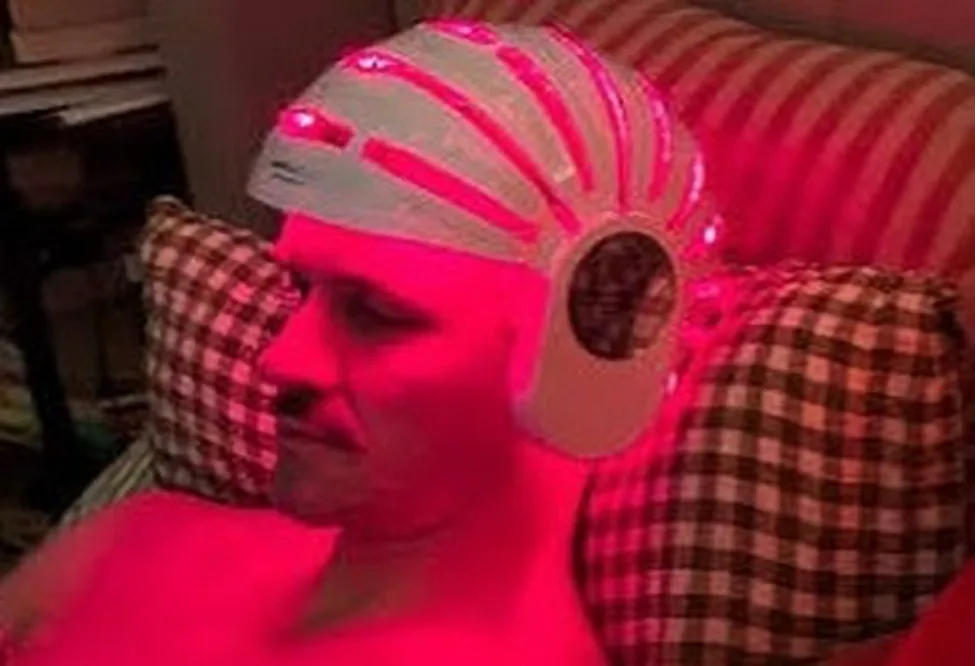
A red light cap/helmet-style device being used at home
If your thinning is spread across a large area of your scalp, a helmet is probably the most convenient option from a coverage perspective.
You put it on.
Switch it on.
And the device treats a large portion of your scalp at once.
No moving it around.
No manually working through different sections.
No trying to remember whether you spent enough time on the left side of your crown.
For someone with diffuse thinning or hair loss affecting the top of the head, that convenience can be a major advantage.
The Pros
- Covers a large area of the scalp at once
- Usually requires very little effort during treatment
- Convenient for people with widespread thinning
- Easy to incorporate into a routine
You can potentially sit down, watch something, answer emails or simply relax while the session runs.
The Cons
The biggest disadvantage?
The price.
High-quality helmets can be expensive.
Very expensive.
And while full scalp coverage sounds fantastic, you still need to consider whether you’re comfortable wearing the device regularly.
Some people may also find helmets bulky or inconvenient to travel with.
So while they are often among the easiest devices to use, they aren’t automatically the best value for everyone.
Red Light Caps
Caps are similar to helmets in the sense that they are designed to cover a significant area of the scalp.
The obvious difference is the design.
Many people prefer caps because they can feel less intimidating and, let’s be honest, less like you’re participating in a science experiment.
Some are designed to be worn discreetly underneath an ordinary-looking baseball cap.
That can make them appealing for people who want something more portable.
The Pros
- Covers a relatively large treatment area
- Often lighter and more portable than helmets
- Hands-free
- Convenient for regular use
The Cons
The quality and coverage can vary significantly between products.
And because the device sits over the head, you still need to make sure it actually provides sufficient coverage for the areas you’re concerned about.
If your thinning extends beyond the areas the cap effectively treats, you may need to think carefully about whether it is the right design for you.
Red Light Combs
Red light combs are among the older and more familiar forms of low-level light therapy devices.
They are designed to be moved manually through the hair, helping the light reach closer to the scalp.
This can be useful because, as anyone with thick hair knows, hair itself can get in the way.
A comb physically parts through sections as you move it.
The Pros
- Can provide direct treatment to specific areas
- Gives you control over where the light goes
- Often more affordable than large helmets
- Useful for targeted thinning
The Cons
They require more effort.
You have to manually work through different areas of your scalp.
That means it can be easier to miss sections or become inconsistent.
And if your thinning is spread across your entire scalp, treating every area manually may become tedious.
Again, the problem isn’t necessarily the technology.
It’s the routine.
Red Light Brushes
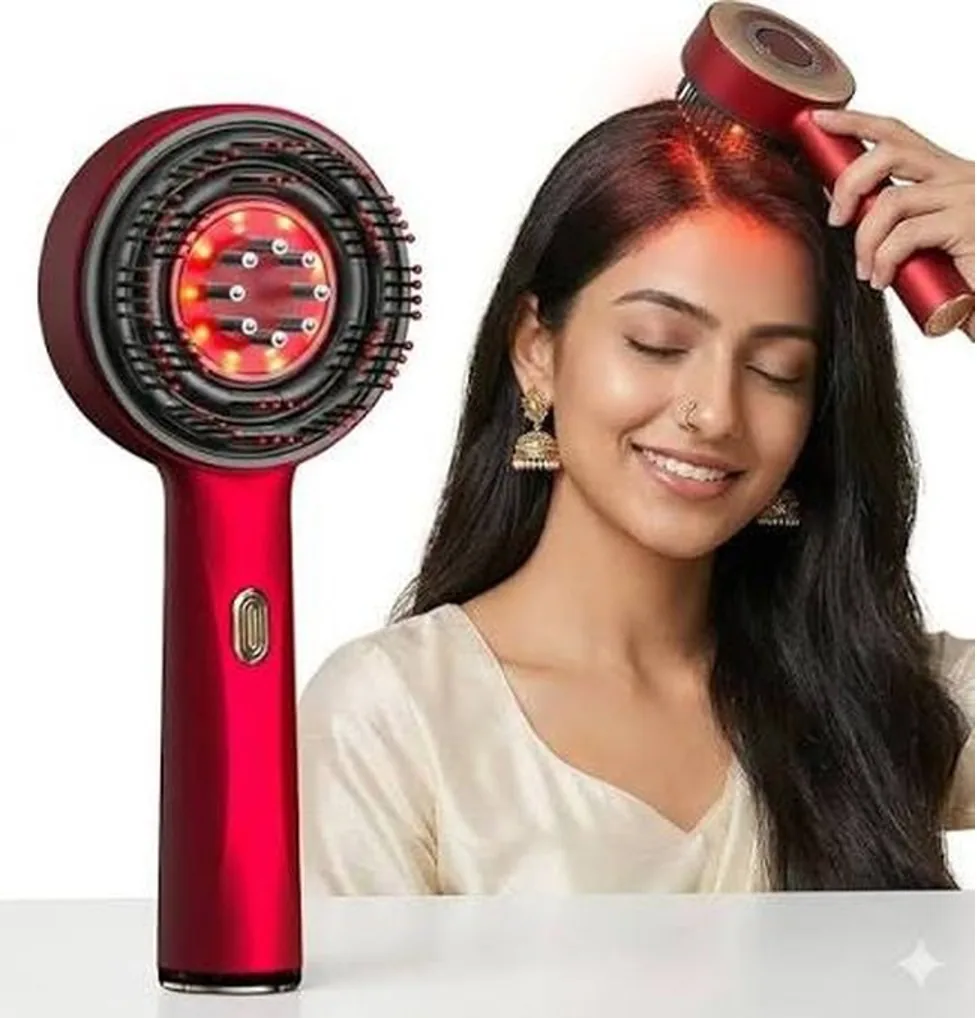
A woman using a handheld red light brush on her scalp
This is where some of the newer devices become particularly interesting.
A red light brush combines the familiar experience of brushing your hair with light therapy directed towards the scalp.
Depending on the product, a brush may also include additional features such as vibration or scalp massage.
Some are even designed with compartments for hair serums or scalp products.
The biggest appeal is obvious.
It feels less like adding another complicated treatment to your life.
Instead of putting on a helmet and waiting, you’re holding something that already resembles a grooming tool.
For someone who struggles to stick to complicated beauty routines, that can be a genuine advantage.
The Pros
- Easy and familiar to use
- Can target specific thinning areas
- Often portable
- May combine light therapy with scalp massage
- Can fit naturally into a daily grooming routine
The Cons
Coverage depends heavily on how you use it.
Unlike a helmet, you are responsible for moving the brush around your scalp.
That means you need to take the time to work through the areas you want to treat.
It may also be less convenient for someone with widespread thinning who wants simultaneous full-scalp coverage.
And, as with every category of red light device, not every brush is equally well designed or supported by evidence.
The fact that a brush glows red does not automatically make it an effective hair-growth treatment.
Handheld Red Light Devices
Then there are handheld devices that don’t necessarily look like traditional combs or brushes.
Some are designed specifically for the scalp.
Others are small panels or targeted devices that you move across the areas you’re concerned about.
These can be useful for people who want precision.
If you are particularly worried about your temples, hairline or one thinning area, being able to target that location directly can be appealing.
The Pros
- Highly targeted treatment
- Portable
- Often easier to store
- Can be useful for specific thinning areas
The Cons
Like combs and brushes, handheld devices require you to do the work.
You need to move them.
You need to remember which areas you’ve treated.
And you need to follow the recommended treatment time.
For someone treating their entire scalp, this can become time-consuming.
So, Which One Should You Choose?
Let’s make this simple.
A helmet may make sense if:
You have widespread thinning and want the convenience of treating a large area at once.
A cap may make sense if:
You want hands-free treatment but prefer something lighter and potentially more portable.
A comb may make sense if:
You want to manually target specific areas and don’t mind spending time working through your scalp.
A brush may make sense if:
You want something that feels more natural as part of your existing hair-care routine and you prefer targeted treatment.
A handheld device may make sense if:
You are focused on particular areas such as your temples, hairline or crown.
But here is the thing I would personally prioritise over almost everything else:
Choose the Device You Are Most Likely to Use.
That might sound almost too simple after everything we’ve discussed about wavelengths, LEDs, lasers and scalp coverage.
But it matters.
A $1,500 helmet that you use six times before abandoning it is not automatically better than a more affordable device you use consistently for months.
The technology matters.
The design matters.
The evidence matters.
But your behaviour matters too.
The best red light therapy device is not necessarily the biggest, most expensive or most futuristic-looking one.
It’s the one that combines credible technology with a routine you can realistically maintain.
Because now we come to the question everyone wants answered before spending their money:
How Long Does Red Light Therapy Take to Work for Hair Loss?
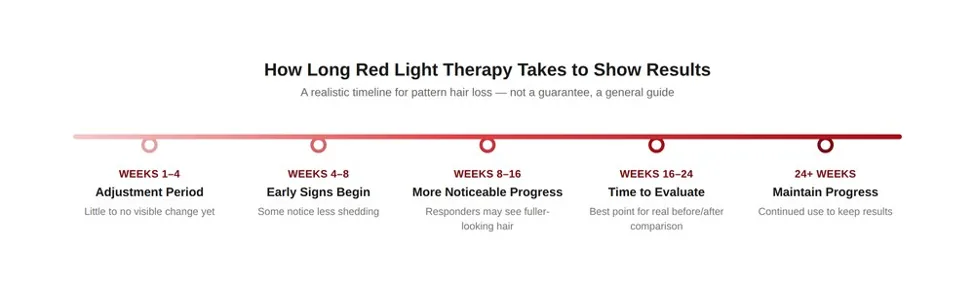
Timeline showing what to expect from red light therapy over 24+ weeks
This is probably the point where a lot of people become impatient.
You’ve bought the device.
You’ve started using it.
You’ve been consistent for a whole week.
Then you stand in front of the mirror, pull your hair back and think:
“Okay… where is my new hair?”
Unfortunately, hair growth does not work that way.
And this is one of the most important things to understand before spending money on red light therapy.
Red Light Therapy Is Not an Overnight Hair-Growth Solution
Even if red light therapy is helping your hair follicles, the visible changes take time.
Hair grows slowly.
The average person is not going to use a red light device for three days and suddenly wake up looking like they belong in a shampoo commercial.
The changes, when they happen, are usually gradual.
And because they are gradual, you may not even notice them immediately.
This is actually one reason before-and-after photographs can be helpful.
When you see yourself every day, small changes can be difficult to recognise.
But compare a photograph from several months ago with one taken today under the same lighting and you may notice changes you completely missed in the mirror.
Weeks 1–4: The Adjustment Period
During the first few weeks, you may not see much visually.
And that’s normal.
Some people may notice that their scalp feels different after treatment, particularly if their device also includes massage or vibration.
Others may simply notice absolutely nothing.
That doesn’t automatically mean the treatment isn’t doing anything.
It also doesn’t mean it definitely is working.
It simply means that visible hair changes usually require more time.
This is where patience becomes part of the treatment.
You have to be willing to continue the routine before you can realistically judge whether it is helping.
Weeks 4–8: Early Changes May Begin
For people who respond to low-level light therapy, this is roughly the period when the very first subtle changes may start to appear.
That might include:
- Less visible scalp in thinning areas
- Hair appearing slightly fuller
- Small new hairs becoming easier to notice
- Existing hair looking thicker or healthier
- Reduced shedding for some people
But this is important.
Weeks 8–16: More Noticeable Progress
Not everyone will experience the same timeline.
Two people can use the same device with the same level of consistency and have completely different experiences.
Why?
Because hair loss is influenced by many things.
Your age.
Your genetics.
The cause of your hair loss.
How long you’ve been experiencing it.
Your overall health.
Whether you are using other treatments.
And, of course, whether the particular treatment actually works well for you.
That is why anyone promising that everyone will have dramatic regrowth in exactly four weeks should immediately make you a little suspicious.
Hair doesn’t operate on a universal customer-service schedule.
Weeks 16–24: A Better Time to Evaluate Results
If you’re going to give red light therapy a genuine chance, a period of several months is usually a much more realistic timeframe for evaluating visible changes.
By this point, someone who is responding may have a clearer idea of whether their hair is improving, maintaining or continuing to thin.
This doesn’t necessarily mean you’ll have reached your final result.
Hair growth is an ongoing biological cycle.
But it gives you a much better opportunity to evaluate whether the routine is worth continuing.
And this is why I strongly recommend taking photographs before starting.
Not random selfies.
Proper comparison photographs.
Take pictures of:
- Your hairline
- Your temples
- Your crown
- Your part
- Any specific thinning area you’re concerned about
Try to use the same lighting.
The same angle.
And preferably the same hairstyle.
Then repeat the photographs regularly.
Because otherwise, your brain will play games with you.
One day you’ll think:
“Wow, I definitely have more hair!”
The next day you’ll stand under a bathroom light and think:
“Actually, I think it’s worse.”
Photographs give you something more objective to compare.
Beyond 24 Weeks: Maintaining Your Progress
For people who are seeing positive changes, the next question becomes:
What happens if I stop?
And this is something people should think about before starting almost any ongoing hair-loss treatment.
If your hair loss has an underlying progressive cause, such as pattern hair loss, maintaining results may require continued treatment.
Stopping the routine could mean losing some of the benefits you gained over time.
This isn’t unique to red light therapy.
Many approaches to managing pattern hair loss require continued use to maintain results.
So don’t think of red light therapy as necessarily being:
“I’ll do this for three months, fix my hair forever and never think about it again.”
For some people, it may become part of their longer-term hair-care routine.
Why Some People See Results Faster Than Others
Let’s say two people buy the same red light device.
They both start on the same day.
Six months later, one person is thrilled.
The other sees almost no change.
What happened?
There are several possibilities.
They Don’t Have the Same Type of Hair Loss
This is probably the biggest one.
If one person has pattern hair loss and the other is losing hair because of an untreated underlying condition, their response may be completely different.
One Person Started Earlier
Someone dealing with mild thinning may have more opportunity to preserve and improve existing hair than someone with advanced hair loss.
Their Consistency Was Different
Using a device occasionally is not the same as following a consistent routine.
And yes, this includes the people who proudly say they have had their device for six months but quietly admit they used it about twelve times.
They Have Different Biology
Unfortunately, human bodies are not identical.
A treatment that produces a noticeable improvement for one person may produce a smaller improvement for another.
That’s why honest discussions about red light therapy should always leave room for the possibility that results vary.
A Word About Shedding
This is something that can make people panic.
You start a new hair routine.
You begin paying much closer attention to your hair.
And suddenly, every strand in the shower feels like evidence that something is going terribly wrong.
Before blaming the red light device, remember that shedding itself can fluctuate naturally and can have many causes.
Hair goes through cycles.
Some days you may notice more strands.
Other days, less.
If you experience significant or worsening hair loss, especially if it is sudden or concerning, it is worth speaking with a healthcare professional rather than assuming it is simply part of your new treatment routine.
Don’t ignore a serious change because someone online told you:
“Trust the process.”
Sometimes trusting the process is good.
Sometimes you need to investigate the problem.
So, How Long Should You Try Red Light Therapy?
There isn’t one universal answer because devices have different instructions and people have different types of hair loss.
But the key point is this:
Don’t judge red light therapy after one week.
Or two weeks.
Or after using the device inconsistently for a month.
If you’re going to invest your money and time into a legitimate red light therapy routine, give yourself enough time to evaluate it properly, while following the manufacturer’s instructions.
Track your progress.
Take photographs.
Pay attention to changes in shedding and hair density.
And most importantly, keep your expectations realistic.
Because the people most likely to become disappointed are often the ones expecting a miracle.
The people who understand that hair improvement takes time are usually in a much better position to recognise genuine progress when it happens.
And that brings us to another important question.
Because even if red light therapy can work, there is still a major issue:
Does Red Light Therapy Work Better on Its Own or With Other Hair-Loss Treatments?
This is where things get interesting.
Because once people discover red light therapy, there is usually one question that follows:
“Do I need to use anything else with it?”
Or, on the other side:
“If I’m already using a hair-growth treatment, is there any point adding red light therapy?”
The answer is not completely straightforward.
Because red light therapy doesn’t necessarily have to be an either-or decision.
For some people, it may become one part of a broader approach to managing hair loss.
And honestly, that makes sense.
Hair loss can be complicated.
There isn’t always one single reason why someone’s hair is thinning, and there isn’t always one magical product that fixes everything.
Can Red Light Therapy Work on Its Own?
Yes, red light therapy can be used as a standalone approach.
That is one of the reasons it appeals to so many people.
You don’t have to take a pill.
You don’t necessarily have to apply medication to your scalp.
You don’t need an appointment every week.
Instead, you can use a device at home as part of your regular routine.
For someone experiencing mild or early-stage thinning, that simplicity can be particularly attractive.
They may not be ready to commit to medication.
They may want a non-invasive option.
Or they may simply want to explore something that fits easily into their existing hair-care routine.
For those people, red light therapy may be worth trying on its own.
But there is something important to remember.
Using red light therapy alone doesn’t mean it will be enough for everyone.
Someone with more aggressive or progressive hair loss may need a different approach.
And this is where combining treatments sometimes enters the conversation.
The Idea Behind Combining Treatments
Think about hair loss like a problem with several possible moving parts.
One treatment may focus on one part of that problem.
Another may address something different.
Red light therapy is believed to support follicular activity through photobiomodulation.
Other treatments may work through completely different mechanisms.
That means, in theory, combining approaches could potentially provide benefits that one approach alone may not provide.
But this is where I want to be careful.
More treatments do not automatically mean better results.
The hair-loss industry has made it incredibly easy to believe that if one product is good, then buying seven products must be even better.
So suddenly you have:
A shampoo.
A conditioner.
A scalp serum.
Hair vitamins.
Rosemary oil.
A supplement.
A scalp massager.
A red light helmet.
And three products you bought at 2 a.m. after watching someone with beautiful hair on TikTok.
The bathroom is full.
Your bank account is crying.
And you still don’t know what is actually helping.
That is why a smarter approach is better than simply throwing everything at your scalp.
Red Light Therapy and Hair Serums
Many people already use serums as part of their hair-care routine.
Depending on the product, these may be designed to support scalp health, reduce the appearance of thinning or encourage healthier-looking hair.
A red light device doesn’t necessarily replace those products.
Instead, some people choose to use both as part of the same routine.
This is particularly relevant to devices designed with scalp contact in mind.
For example, some red light brushes are designed to physically move through the hair and reach the scalp, while certain products also include massage features or compartments for applying scalp products.
The appeal is convenience.
Instead of having a complicated routine involving multiple separate steps, the device may help combine parts of the process.
But again, convenience should not be confused with proof that every serum will suddenly become dramatically more effective.
The product itself still matters.
And the cause of your hair loss still matters.
Red Light Therapy and Medically Recommended Treatments
This is where it becomes particularly important to separate general hair-care advice from medical treatment.
Some people use red light therapy alongside treatments recommended by a doctor or dermatologist.
That doesn’t necessarily mean everyone should start combining treatments without guidance.
If you’re already treating hair loss with medication, especially prescription medication, it makes sense to speak with a qualified healthcare professional before changing your routine.
The goal should be to understand what you’re using and why.
Not simply to keep adding products until your scalp becomes the world’s most expensive science experiment.
What About Red Light Therapy and Scalp Massage?
This combination is probably easier to understand.
Scalp massage is already something many people enjoy as part of their hair-care routine.
It can feel relaxing.
It can make your scalp feel stimulated.
And, depending on the device, a red light brush may combine the experience of scalp massage with light therapy.
This is one reason handheld brushes can be appealing.
You’re not just sitting under a light.
You’re actively working through your scalp.
For someone who enjoys the sensation of massage and prefers a more hands-on routine, that can make the experience easier to stick with.
And as we’ve said several times throughout this article:
The best routine is often the one you can actually maintain.
Could Red Light Therapy Be Part of a Complete Hair Routine?
Absolutely.
But the word here is part.
Not necessarily the entire solution.
Someone with healthy hair goals might focus on several areas at once:
- Understanding the cause of their hair loss
- Taking care of their scalp
- Using appropriate treatments where necessary
- Avoiding unnecessary damage to the hair
- Maintaining good overall nutrition
- Managing conditions contributing to hair loss
- Using supportive tools such as red light therapy when appropriate
This approach is much more realistic than believing one device will solve every possible hair problem.
So Should You Combine Red Light Therapy With Other Treatments?
It depends.
If you have mild thinning and want a simple, non-invasive routine, you may decide to try red light therapy on its own.
If you already have an established hair-loss treatment plan, red light therapy may be something you discuss with a professional as an additional tool.
And if your hair loss is sudden, severe or unexplained, the priority should still be understanding what is causing it.
Because the most expensive mistake you can make isn’t buying the wrong red light device.
It’s spending months treating the wrong problem.
The Bottom Line: Red Light Therapy Doesn’t Have to Do Everything
One of the reasons I think red light therapy has become so popular is because it feels simple.
No surgery.
No needles.
No dramatic procedure.
You use a device.
You stay consistent.
And you give your hair time.
That simplicity is appealing.
But simple doesn’t mean magical.
Red light therapy may be useful on its own for some people.
It may work better as part of a broader strategy for others.
And for some people, it may not be the right approach at all.
The key is knowing which category you fall into.
And that brings us to something equally important before you spend your money:
How to Choose a Red Light Therapy Device for Hair Loss Without Wasting Your Money
By now, you’ve probably realised something.
Red light therapy devices are not all the same.
And unfortunately, the internet makes choosing one much harder than it needs to be.
You can find devices for relatively affordable prices.
Then you can find another device that looks almost identical but costs hundreds or even thousands more.
One promises clinical technology.
Another promises professional-grade results.
Someone else claims their device has five different wavelengths, 300 LEDs and technology that sounds like it was developed at NASA.
So how do you know what actually matters?
And more importantly:
How do you avoid spending a ridiculous amount of money on a device that looks impressive but doesn’t give you what you need?
Here are the things I would personally look at before buying a red light therapy device for hair loss.
1. Make Sure It Is Actually Designed for the Scalp
This sounds obvious, but it matters.
Not every red light device is designed for hair growth.
You can buy red light panels for your face.
Devices for muscle recovery.
Devices marketed for skin concerns.
General wellness lights.
But your scalp presents a unique challenge.
You have hair in the way.
The light needs to reach the areas you’re trying to treat, and thick hair can make that more difficult.
That is why devices designed specifically for the scalp can be more practical.
Helmets, caps, combs and brushes are shaped with this purpose in mind.
A brush or comb can physically move through sections of hair.
A helmet can position lights around the head.
A cap can provide broader coverage without requiring you to manually move the device.
So before being impressed by the fact that something glows red, ask:
Was this actually designed for treating the scalp?
Because a beautiful red light panel sitting six feet away from your head isn’t necessarily the same thing as a device designed to reach your hair follicles.
2. Look Beyond Fancy Marketing Words
This is where you need to become slightly suspicious.
Not cynical.
Just suspicious.
The red light therapy industry has discovered some very powerful words.
Words like:
Professional.
Clinical-grade.
Advanced technology.
Medical-strength.
Professional results.
The problem?
Those phrases don’t always tell you very much on their own.
A product can call itself advanced without explaining what makes it advanced.
So instead of being persuaded by impressive adjectives, look for actual information.
Does the company explain:
- What type of light the device uses?
- The wavelength?
- How the device is meant to be used?
- How long each session should last?
- Which areas of the scalp it is designed to treat?
- What results users can realistically expect?
Transparency is important.
A company selling a device for hundreds of dollars should be able to explain what you are buying.
3. Pay Attention to the Wavelength
We’ve already discussed this, but it is worth mentioning again because wavelength is one of the specifications you’ll see repeatedly when shopping.
Many devices designed for hair-related light therapy use wavelengths within the red-light range.
Some may also include near-infrared wavelengths.
The important thing is not to become obsessed with finding the device that has the longest list of numbers.
More numbers do not automatically mean better results.
A company can list multiple wavelengths and make the product sound incredibly sophisticated.
That doesn’t automatically mean those additional wavelengths will produce better hair-growth results for you.
Instead, look for a company that clearly explains its technology rather than simply throwing technical specifications onto the page and hoping you’re impressed.
Because honestly, if a product description makes you feel like you need a physics degree before you can buy a hairbrush, something has gone wrong.
4. Think About Coverage
Where exactly are you experiencing thinning?
This should influence the type of device you choose.
If your hair is thinning mainly around your:
- Hairline
- Temples
- Crown
- Part
A handheld device may give you the control you want.
You can focus directly on the areas that concern you.
But if your thinning is more widespread, manually treating your entire scalp every day may become frustrating.
In that situation, a helmet or cap could make more sense because it covers a larger area at once.
There is no universal answer.
The right device for someone with a widening part may not be the right device for someone with thinning across their entire scalp.
Choose based on your hair-loss pattern, not just what looks coolest online.
5. Consider How Much Effort the Routine Requires
This might honestly be one of the most important things on the entire list.
Let’s say Device A has incredible specifications.
Excellent coverage.
Fantastic technology.
Lots of impressive research behind the general type of treatment.
But using it requires you to:
Charge it.
Set it up.
Sit in one position.
Treat multiple sections.
Keep track of time.
Clean it afterwards.
And sacrifice part of your evening.
Now let’s say Device B is simpler.
You pick it up.
Use it as part of your existing grooming routine.
And put it away.
Which one are you more likely to use for 16 weeks?
The answer matters.
Because consistency is one of the biggest parts of any red light therapy routine.
Don’t buy based only on what a device can do.
Buy based partly on what you will realistically do with it.
6. Don’t Assume the Most Expensive Device Is Automatically the Best
This one deserves to be printed in very large letters.
EXPENSIVE DOES NOT AUTOMATICALLY MEAN BETTER.
A higher price may sometimes reflect:
- More lights
- Greater scalp coverage
- Better construction
- Additional features
- More established technology
- Better customer support
But sometimes?
You’re also paying for branding.
Marketing.
Packaging.
And the fact that the device looks like something from a luxury wellness spa.
Price should be one factor in your decision.
Not the entire decision.
Compare what you’re actually getting.
And ask yourself whether the additional features genuinely matter for your needs.
7. Look at the Return Policy
This is something I would strongly consider before buying any expensive hair-growth device.
Why?
Because you cannot always know how your scalp or hair will respond.
And you also cannot guarantee that you’ll like the experience of using the device.
A company offering a reasonable return period gives you more flexibility.
But read the policy carefully.
Ask:
- How long is the return window?
- Can the device actually be used and returned?
- Are there conditions attached?
- Who pays for return shipping?
- Is there a restocking fee?
- Does the guarantee apply if you simply aren’t satisfied?
Don’t wait until after spending your money to discover that the “money-back guarantee” has seventeen conditions written in microscopic text.
8. Be Careful With Before-and-After Pictures
We already covered why before-and-after photographs can be misleading, lighting, angle, styling and hair fibres can all make a scalp look better or worse than it actually is, so we won’t repeat the full list here.
As a buying rule, the takeaway is simple.
A dramatic before-and-after on a product page doesn’t automatically mean it’s fake.
But it also isn’t evidence.
Treat it as marketing, and look at the company’s actual claims and specifications instead of being sold purely on a photo.
And when you start your own red light therapy journey, take your own baseline photographs before you begin.
Because comparing yourself to someone else’s dramatic transformation will never tell you whether your hair is improving.
9. Read Reviews, But Read Them Carefully
Reviews can be incredibly helpful.
They can also be incredibly confusing.
One person says:
“This completely changed my hair!”
Another says:
“Total waste of money.”
Welcome to the internet.
Remember that both people may be telling the truth about their own experience.
They may have different causes of hair loss.
Different levels of thinning.
Different routines.
Different expectations.
Different levels of consistency.
So instead of looking only at the overall star rating, pay attention to the details.
Look for patterns.
Do multiple people mention the same benefit?
Do multiple people complain about the same issue?
Is the device easy to use?
Does it feel comfortable?
How is the company’s customer service?
Are people actually using it consistently before judging the results?
These details can tell you much more than simply seeing 4.9 stars beside a product.
10. Be Honest About What You Expect From It
Before clicking Buy Now, ask yourself:
What exactly am I hoping this device will do?
If your answer is:
“I want to support my existing hair and potentially improve mild thinning.”
That may be a realistic reason to explore red light therapy.
If your answer is:
“I want to completely regrow all the hair I lost over the last 20 years.”
Then you may be setting yourself up for disappointment.
The right device cannot fix unrealistic expectations.
And honestly, this is probably the biggest piece of advice I would give anyone shopping for red light therapy.
Buy the Device That Matches Your Situation
Not the one with the loudest advertisement.
Not necessarily the one with the most celebrity endorsements.
Not automatically the most expensive one.
And definitely not the one you bought because someone on TikTok had incredible hair and said:
“Guys, you NEED this!”
Look at your own situation.
Your type of thinning.
Your budget.
Your lifestyle.
The amount of scalp you want to treat.
And how likely you are to stick with the routine.
Because at the end of the day, red light therapy is not really about buying the fanciest glowing gadget.
It’s about finding an approach that makes sense for you and using it consistently enough to give it a fair chance.
And now there is one final question we need to answer.
The question that brings this entire article together:
So, Is Red Light Therapy for Hair Loss Actually Worth It?
After everything we’ve discussed, we finally arrive at the question that probably brought you here in the first place.
Is red light therapy for hair loss actually worth it?
Or is it simply another beauty and wellness trend wrapped in futuristic technology and expensive marketing?
The honest answer is:
For the right person, it may absolutely be worth considering.
But it is not a miracle.
And I think that’s actually the most important conclusion we can reach.
The problem with the hair-loss industry is that almost everything is marketed as a miracle.
The miracle oil.
The miracle vitamin.
The miracle shampoo.
The miracle serum.
The miracle device.
Everyone promises to be the thing you’ve been searching for.
And when you’re worried about losing your hair, those promises can be incredibly tempting.
Because hair loss isn’t just about hair.
For many people, it’s about confidence.
It’s about looking in the mirror and noticing that something has changed.
It’s about avoiding certain hairstyles because they reveal too much scalp.
It’s about standing under bright lights and suddenly becoming very aware of your hairline.
It’s about looking at old photographs and thinking:
“Wow. My hair really was thicker then.”
So yes, it’s understandable that people want a solution.
And that is exactly why we need to separate hope from hype.
The Good News: Red Light Therapy Isn’t Just Another Random Hair Trend
One of the reasons red light therapy has attracted so much attention is that low-level light therapy has actually been studied for hair growth.
That doesn’t mean every glowing red device sold online has been proven to work.
And it doesn’t mean every person will see dramatic regrowth.
But the general technology behind low-level light therapy has enough scientific interest to make it more than just another internet trend.
For people experiencing certain types of hair thinning, particularly pattern hair loss, red light therapy may help support improvements in hair density and thickness when used consistently.
That is important.
Because there is a huge difference between saying:
“This device will definitely grow your hair back.”
And saying:
“This type of therapy may help some people improve or maintain their hair when used consistently.”
The second statement may not sound as exciting.
But it’s the more useful one.
What Makes Red Light Therapy Worth Considering?
For me, the biggest appeal comes down to a few things.
It Is Non-Invasive
You don’t need surgery.
You don’t need needles.
You don’t need to spend every week sitting in a clinic.
For many people, being able to explore an at-home option is incredibly appealing.
It Can Fit Into Your Routine
Depending on the device you choose, treatment can be relatively easy to incorporate into everyday life.
You may use a cap while relaxing.
A helmet while watching television.
A comb or brush as part of your grooming routine.
This matters more than people realise.
Because a complicated treatment that you hate doing is much harder to maintain.
It Doesn’t Require Overnight Transformation
Wait.
That sounds like a disadvantage, doesn’t it?
But hear me out.
The fact that red light therapy requires time actually helps us judge it more realistically.
Hair growth is naturally slow.
Any product promising dramatic results in a few days should probably make you more suspicious, not less.
A treatment that requires consistency and patience may be less exciting.
But at least it respects the fact that your body isn’t Amazon Prime.
You can’t place an order on Monday and expect a full head of hair by Wednesday.
It May Help You Take Action Earlier
One of the biggest mistakes people make with hair thinning is waiting.
They notice changes.
They ignore them.
They hope things will magically improve.
Then years later, the thinning has progressed.
A red light device isn’t necessarily the answer for everyone.
But for someone with gradual thinning who wants to start taking their hair and scalp health more seriously, it may provide a practical way to begin.
But Here’s When I Wouldn’t Rush to Buy One
This article would not be complete if I simply told everyone to run out and buy a red light device.
There are situations where I would pause first.
If your hair loss is sudden.
If you’re losing large amounts of hair unexpectedly.
If you have patchy bald spots.
If your scalp is painful or severely irritated.
If your hair loss is progressing rapidly.
If you have no idea why your hair is falling out.
Find out what is happening first.
Because red light therapy cannot replace understanding the cause of your hair loss.
And spending money on devices while ignoring an underlying issue can waste more than just money.
It can waste valuable time.
The Biggest Mistake You Can Make Is Expecting a Miracle
This is where people often go wrong.
They see an incredible before-and-after picture.
They become excited.
They buy the device.
And they expect the same transformation.
But your hair is not someone else’s hair.
Your genetics are different.
Your age is different.
Your type of hair loss may be different.
Your routine may be different.
Your biology is different.
And your results may be different too.
That doesn’t mean you shouldn’t be hopeful.
It simply means your expectations should leave room for reality.
Maybe your hair becomes noticeably fuller.
Maybe your shedding reduces.
Maybe your part looks less wide.
Maybe you maintain the hair you already have.
Maybe you see little change.
All of those possibilities exist.
And an honest review of red light therapy has to acknowledge that.
So, Who Should Consider Trying It?
Based on everything we’ve discussed, red light therapy may be worth exploring if you:
- Are experiencing gradual hair thinning
- Have male or female pattern hair loss
- Still have hair in the thinning areas
- Want a non-invasive approach
- Are willing to be consistent
- Can commit to using the device for several weeks
- Have realistic expectations
- Understand that results vary
It may be particularly appealing to someone who wants to take action without immediately moving towards more invasive procedures.
Who Should Probably Pause Before Buying?
I would be more cautious if you:
- Have sudden or unexplained hair loss
- Are developing patchy bald spots
- Have significant scalp pain or irritation
- Expect a completely bald area to suddenly become fully covered
- Want dramatic results within a few days or weeks
- Know you are unlikely to stick to a regular routine
And honestly, that last point is worth considering.
Because if you already know that after two weeks your device will probably join the collection of abandoned wellness products in your cupboard, save yourself the money.
My Honest Verdict
So, is red light therapy as good as people think?
Yes and no.
Yes, because the technology behind low-level light therapy for hair loss is more credible than many of the miracle products constantly appearing online.
There is genuine scientific interest in how light-based therapy may support hair growth.
For the right person, consistent use may lead to meaningful improvements.
But no, because some of the marketing surrounding red light therapy makes it sound far more predictable than it really is.
Not everyone will respond the same way.
Not every device is equally good.
And no one should promise you a guaranteed full head of hair.
The truth sits somewhere in the middle.
Red Light Therapy Is a Tool, Not Magic
And I think this is the best way to look at it.
Red light therapy is a tool.
Like many tools, its usefulness depends on the situation.
The right tool can be incredibly helpful.
The wrong tool can be completely useless.
And even the right tool won’t help much if you never use it.
If you have the type of hair thinning that may respond to low-level light therapy, choose a credible device, follow the recommended routine and give it enough time.
Track your progress.
Take photographs.
Pay attention to genuine changes rather than checking the mirror every morning and expecting a miracle.
And if you aren’t sure why your hair is thinning?
Start there.
Because understanding your hair loss will always be more valuable than blindly buying every product promising to fix it.
Final Thoughts
Hair loss has created an enormous industry because the emotional impact of losing your hair is real.
People want answers.
They want solutions.
And most importantly, they want to feel like they still have some control over what is happening.
Red light therapy offers something that many people find appealing:
A non-invasive, at-home approach that may support healthier, fuller-looking hair with consistent use.
Is it perfect?
No.
Is it guaranteed?
No.
Is it likely to work for every type of hair loss?
Definitely not.
But is it something worth taking seriously rather than dismissing as another internet gimmick?
Yes.
The science is still developing.
The results vary.
And the marketing can sometimes get carried away.
But for the right person, with realistic expectations and a willingness to stay consistent, red light therapy may be a worthwhile addition to their hair-loss routine.
The most important thing is not to ask:
“Will this magically give me the hair I had at 21?”
Instead, ask:
“Is this a realistic tool that could help me improve or maintain my hair based on my particular situation?”
That is the question that will help you make a smarter decision.
And perhaps, in an industry filled with miracle promises, a smarter decision is exactly what we need.
Frequently Asked Questions About Red Light Therapy for Hair Loss
By now, we’ve covered the science, the potential benefits, the limitations and the different types of red light therapy devices available.
But before you spend money on one, there are still some very practical questions worth answering.
These are the questions many people have when they’re considering red light therapy for hair loss.
Does Red Light Therapy Really Help With Hair Growth?
Red light therapy may help support hair growth in some people, particularly those experiencing certain types of thinning, such as male or female pattern hair loss.
Low-level light therapy has been studied for its potential effects on hair follicles, including supporting cellular activity and helping follicles remain in the growth phase.
But it is important to manage expectations.
Red light therapy does not guarantee hair regrowth for everyone.
Your results can depend on several factors, including:
- The cause of your hair loss
- How long you have been experiencing thinning
- Whether hair follicles are still active
- Your genetics
- Your overall health
- The device you use
- How consistently you use it
For some people, the biggest benefit may be thicker-looking hair or reduced shedding.
Others may notice new growth over time.
And some people may see very little change.
That is why red light therapy should be viewed as a potential tool for supporting hair growth rather than a guaranteed cure for every type of hair loss.
How Many Weeks Does Red Light Therapy Take to Work for Hair Loss?
This is probably one of the most common questions.
And unfortunately, there is no honest answer that says:
“Use it on Monday and by Friday your hair will be back.”
Hair grows slowly.
That means meaningful changes usually require patience and consistency.
Some people may notice early changes in their scalp or shedding after several weeks of consistent use.
More noticeable changes in hair thickness or density can take considerably longer.
The key word here is:
Consistency.
Using a red light device occasionally and expecting dramatic results is unlikely to give you a clear idea of whether the treatment is helping.
Follow the instructions provided with your specific device and give the routine enough time before judging the results.
Taking photographs every few weeks can also be more useful than checking your hair in the mirror every single day.
Because when you see yourself daily, gradual changes can be surprisingly difficult to notice.
Can Red Light Therapy Burn Your Scalp?
This is a completely understandable concern, especially for people who hear the words “light therapy” and immediately imagine something hot shining onto their skin.
But red light therapy is not the same thing as sitting under a heat lamp.
The red light used in low-level light therapy devices is generally designed to deliver light energy rather than intense heat.
A properly functioning device used according to the manufacturer’s instructions should not feel like it is burning your scalp.
Some devices may feel slightly warm after being used for a period of time, depending on their design.
But burning, pain or significant discomfort is not something you should ignore.
If a device becomes excessively hot or causes irritation, stop using it and check the manufacturer’s instructions or contact the company.
Is Red Light Therapy the Same as UV Light?
No.
And this distinction is extremely important.
Red light therapy and ultraviolet light are not the same thing.
UV light is the type of radiation associated with sunlight exposure and tanning beds. Excessive exposure to UV radiation can damage the skin and increase the risk of skin cancer.
Red light therapy devices use a completely different part of the light spectrum.
So using a red light therapy device is not the same as exposing your scalp to UV radiation.
That said, you should still use any device responsibly and according to its instructions.
More is not always better.
If a device recommends a particular treatment time, don’t assume doubling that time will automatically double your results.
Can Red Light Therapy Cause Cancer?
Red light therapy is different from ultraviolet radiation, which is the type of light most commonly associated with skin damage and increased skin cancer risk.
Red light devices designed for low-level light therapy do not work by exposing your skin to UV rays.
However, if you have a medical condition, a history of skin cancer or concerns about light sensitivity, it is always sensible to speak with a qualified healthcare professional before starting a new light-based treatment.
Can I Use Red Light Therapy Every Day?
That depends on the specific device.
Different devices have different recommended treatment schedules.
Some may be designed for frequent use, while others may recommend several sessions per week.
This is why you should always follow the instructions for the device you purchase.
One of the biggest mistakes people make with beauty and wellness treatments is thinking:
“If a little is good, more must be better.”
Not necessarily.
Stick to the recommended schedule and focus on consistency rather than overdoing it.
Does Red Light Therapy Work for Women?
Yes, red light therapy can be considered by women experiencing certain types of hair thinning.
Women may experience hair loss for many different reasons, including genetics, hormonal changes, stress, nutritional deficiencies and postpartum changes.
That is why identifying the possible cause of thinning is important.
A woman experiencing gradual pattern thinning may have a very different situation from someone experiencing sudden hair loss after illness or significant shedding after pregnancy.
Red light therapy may be a useful option for some women, but it should not replace understanding why the hair loss is happening.
Does Red Light Therapy Work for Men?
Yes. Men experiencing certain types of hair thinning, particularly male pattern hair loss, may also consider low-level light therapy.
Again, results vary.
The earlier someone addresses progressive thinning, the more potential there may be for supporting existing follicles that are still producing hair.
This is why waiting until an area has been completely bald for many years and then expecting a device to restore everything can lead to unrealistic expectations.
Can Red Light Therapy Help With a Receding Hairline?
It may help some people experiencing thinning around the hairline, depending on the cause and progression of their hair loss.
However, a receding hairline can be caused by different forms of hair loss, particularly genetic pattern hair loss.
The important question is whether the follicles in that area are still capable of producing hair.
Red light therapy may be more useful for areas where hair is thinning or becoming finer than for areas where follicles have been inactive for a very long time.
Can Red Light Therapy Help With a Widening Hair Part?
A widening part is one of the signs that may concern people experiencing pattern hair thinning.
Because red light therapy devices are designed to target the scalp, some people choose to focus treatment around areas such as the part or crown.
Whether it will help depends on the underlying cause of the thinning and the individual.
If your part is suddenly becoming significantly wider, it may be worth investigating why rather than immediately assuming that a red light device alone is the answer.
Can Red Light Therapy Stop Hair Shedding?
Red light therapy should not be viewed as a guaranteed way to immediately stop shedding.
Hair shedding can happen for many reasons.
Stress.
Hormonal changes.
Illness.
Nutritional deficiencies.
Postpartum changes.
Medication.
Genetics.
And other underlying conditions.
If your hair shedding is sudden or unusually heavy, understanding the cause should come before relying on a device.
For people experiencing certain forms of progressive thinning, consistent treatment may potentially support healthier hair growth over time, but individual results vary.
Can Red Light Therapy Make Hair Loss Worse?
Red light therapy is not generally intended to cause hair loss.
However, hair growth and shedding can naturally fluctuate.
If you notice significant or worsening hair loss after beginning any new treatment, it is worth paying attention to what is happening rather than simply assuming it is part of the process.
You may be experiencing an unrelated form of shedding or an underlying condition that needs attention.
When in doubt, speak with a dermatologist or qualified healthcare professional.
Is a Red Light Cap Better Than a Red Light Brush?
Neither is automatically better for everyone.
It depends on your needs.
A red light cap or helmet may be more convenient for treating a larger area of the scalp at one time.
A red light brush or comb may give you more control over specific areas, such as your hairline, temples, crown or widening part.
The best device is often the one that:
- Suits your pattern of hair loss.
- Fits into your lifestyle.
- Is comfortable to use.
- You can realistically use consistently.
Because the most advanced device in the world will not help much if it spends six months inside your drawer.
Should I Use Red Light Therapy With Other Hair Treatments?
Some people incorporate red light therapy into a broader hair-care or hair-loss routine.
However, the best approach depends on the cause of your hair loss and the other treatments you are using.
If you are already using prescription medication or medical treatments for hair loss, speak with your doctor or dermatologist about whether and how red light therapy fits into your routine.
It is always better to understand how your treatments work together than to throw ten different products at your scalp and hope something sticks.
Is Red Light Therapy Worth the Money?
That depends on your expectations.
If you expect a device to magically restore every strand of hair you’ve ever lost, you may be disappointed.
But if you understand that red light therapy is a long-term, non-invasive approach that may help support hair growth and scalp health for some people, it may be worth considering.
Before buying, look at:
- The type of device
- Whether it is designed specifically for the scalp
- The manufacturer’s instructions
- The technology being used
- Ease of use
- Return policy
- Warranty
- Your budget
And most importantly:
Ask whether you are genuinely willing to use it consistently.
Because with red light therapy, buying the device is only the beginning.
The real question is what happens after it arrives.
The Bottom Line
Red light therapy for hair loss is neither the miracle some advertisements make it sound like nor something that should automatically be dismissed as a gimmick.
The truth is more interesting than either extreme.
For the right person, it may be a useful, non-invasive tool for supporting healthier, fuller-looking hair.
But it requires realistic expectations.
Patience.
And consistency.
If you’re considering trying it, understand what type of hair loss you have, choose your device carefully and give yourself enough time to judge whether it is actually helping.
Because when it comes to hair growth, there is rarely one magic answer.
But sometimes, finding the right combination of knowledge, treatment and consistency can make a meaningful difference.